
By Maggie Sun, Managing Broker · Updated September 2026
What you should walk away with: a fillable worksheet you can complete for any specific Seattle address, a fully worked illustrative example showing the math, and the lines most buyers get wrong.
Data definitions used throughout: all market figures are NWMLS closed sales unless stated otherwise; property type is Single Family (detached) unless a line says Condominium; the geography is named on every line; the window is the most recent reported month or a three-month rolling window as labeled. Tax figures come from the King County Assessor, the Washington State Department of Revenue (WA DOR) and the IRS. School information comes from the district's own published materials.
Contents
- The worksheet: every line that makes up your real monthly cost
- Line by line, with the traps
- Closing costs: the one-time layer
- Worked example (illustrative figures)
- Seattle-specific risks that show up as cost
- A decision method: does this specific home fit your budget
- Common mistakes buyers make with the worksheet
- How different buyer profiles use this worksheet
- Execution timeline: when to gather each number
- FAQ
- What our team is seeing
- About the author
- Sources
The worksheet: every line that makes up your real monthly cost
Most affordability conversations stop at principal and interest, which is the one number a lender hands you for free. On a fixed-rate loan the principal-and-interest portion alone stays level for the life of the loan; on an adjustable-rate mortgage (ARM) that portion can change at each reset, and on either loan type your total payment will still move if your lender escrows taxes and insurance and those amounts change. Everything else on this worksheet moves, and in Seattle the moving lines have grown faster than principal and interest over the last several years. Fill in all nine lines below for the specific address you are considering — this is a genuine worksheet, so leave the amount columns blank until you have a real number, and do not guess.
Escrow warning: if your mortgage servicer collects property tax and insurance into an escrow account and folds them into your single monthly payment, do not also add lines 2 and 3 on top of your principal-and-interest line — you will double-count. Use this worksheet to see the full picture, then check your loan estimate or closing disclosure to see which lines your servicer already bundles into "PITI" (principal, interest, taxes, insurance).
| Line | Monthly $ | Annual $ | Where to source the number |
|---|---|---|---|
| 1. Principal and interest | $______ | $______ | Lender quote for your actual loan amount, rate and term; confirm fixed-rate vs. ARM |
| 2. Property tax | $______ | $______ | King County property tax search, by parcel — never the listing page estimate |
| 3. Homeowners insurance | $______ | $______ | Bind a real quote during your inspection window; compare carriers via the WA Office of the Insurance Commissioner |
| 4. Private mortgage insurance (PMI) or MIP, if applicable | $______ | $______ | Applies mainly to lower down-payment loans; ask your lender when it drops off — see CFPB: what is private mortgage insurance |
| 5. HOA regular dues | $______ | $______ | Resale certificate, plus the reserve study |
| 6. HOA special assessments (planned or likely) | $______ | $______ | Reserve study funding level and board meeting minutes — ask directly whether one is planned |
| 7. Utilities (water, sewer, garbage, power, gas) | $______ | $______ | Seller's 12-month history where available; Seattle City Light and Seattle Public Utilities for rate schedules |
| 8. Maintenance reserve | $______ | $______ | Budget as a percentage of replacement cost, set aside monthly |
| Total monthly ownership cost | $______ | $______ | Sum lines 1–8; check against your escrow statement so you do not double-count taxes or insurance already bundled into line 1 |
General background on how these pieces fit together, and on typical closing and ongoing costs of homeownership, is also covered by the CFPB Owning a Home resource.
Line by line, with the traps
Property tax is the line most often copied from a listing page and most often wrong. Washington runs a budget-based system: taxing districts set the levy amounts and the rate is derived, so your assessed value rising does not automatically raise your bill by the same percentage, and voter-approved levies are not bound by the 1% growth limit that applies to regular levies. New construction is the sharpest trap — a first-year bill frequently reflects land value only, and the second-year bill after improvements are assessed can jump substantially. Underwrite the second-year number, not the first, using the King County property tax search. If you believe an assessment is wrong, you can appeal through the King County Board of Equalization.
Insurance has moved faster than most buyers expect. Roof age, electrical panel type, plumbing material and prior claims all drive the quote, and a home that is cheap to buy can be expensive to insure. Get a bindable quote during the inspection period — whether that lets you walk away from the purchase depends on the contingencies actually written into your specific purchase and sale agreement, so confirm your inspection and financing contingency terms with your agent and lender rather than assuming you can exit automatically. The WA Office of the Insurance Commissioner publishes consumer guidance on shopping for coverage.
Mortgage insurance (PMI on conventional loans, MIP on FHA loans) applies mainly when the down payment is below a lender's threshold, and it is easy to forget because it is not on every loan. Ask your lender whether it applies to your loan, what it costs monthly, and under what conditions it can be removed — see the CFPB explainer on private mortgage insurance.
HOA dues and special assessments are only half the picture on a condo if you look at the monthly due alone. Read the reserve study and the minutes, and ask directly whether a special assessment is planned or has been discussed. An underfunded association with deferred building envelope work is a special assessment waiting to happen, and in Seattle's climate envelope work is expensive. A low monthly due with no reserves is more risk, not less cost — it is a cost deferred, not a cost avoided.
Maintenance is not optional in this climate. Rain, drainage and moisture management drive a predictable spend on roofing, gutters, siding and crawl spaces. Treat it as a monthly transfer into a reserve account, not as an occasional surprise. Property tax, insurance and the maintenance reserve are the three lines we return to throughout this article; use the worksheet above as the single place to record and update all three rather than re-deriving them section by section.

Closing costs: the one-time layer
Separate from the monthly worksheet, plan for one-time costs at closing: lender fees and points, appraisal, title insurance, escrow fees, recording, prepaid taxes and insurance, and your prorated share of property tax and HOA dues. Our companion guide, How Much Are Closing Costs in Washington, walks through each line in more detail. Note that in Washington the Real Estate Excise Tax (REET) is paid by the seller, not the buyer, at rates set by the WA DOR that generally run roughly 1.1% to 3.0% of the sale price depending on the tier — this is a frequent point of confusion for buyers arriving from other states and countries, and it is worth understanding even as a buyer because it affects how sellers price and negotiate.
Worked example (illustrative figures, not actual data)
The figures below are an illustrative example, not actual data for any real listing or address — they exist only to show how the arithmetic on the worksheet works. Replace every number with your own lender quote, your own parcel's tax record, and your own bound insurance quote before you rely on a total.
| Line | Illustrative monthly $ | Illustrative annual $ |
|---|---|---|
| 1. Principal and interest (illustrative loan amount and rate) | $3,200 | $38,400 |
| 2. Property tax (illustrative) | $650 | $7,800 |
| 3. Homeowners insurance (illustrative) | $140 | $1,680 |
| 4. Mortgage insurance (illustrative, assumes it applies) | $110 | $1,320 |
| 5. HOA regular dues (illustrative; $0 if single family with no HOA) | $0 | $0 |
| 6. HOA special assessment allowance (illustrative) | $0 | $0 |
| 7. Utilities (illustrative) | $260 | $3,120 |
| 8. Maintenance reserve (illustrative) | $300 | $3,600 |
| Illustrative total | $4,660 | $55,920 |
In this illustrative example, principal and interest alone understates the true monthly cost by roughly $1,460, or about 31%. That gap — not the headline mortgage payment — is what a buyer should compare against rent or against a second candidate property, as described in the decision method below. Again: every number in this table is illustrative and must be replaced with your own quotes before you rely on it.
Seattle-specific risks that show up as cost
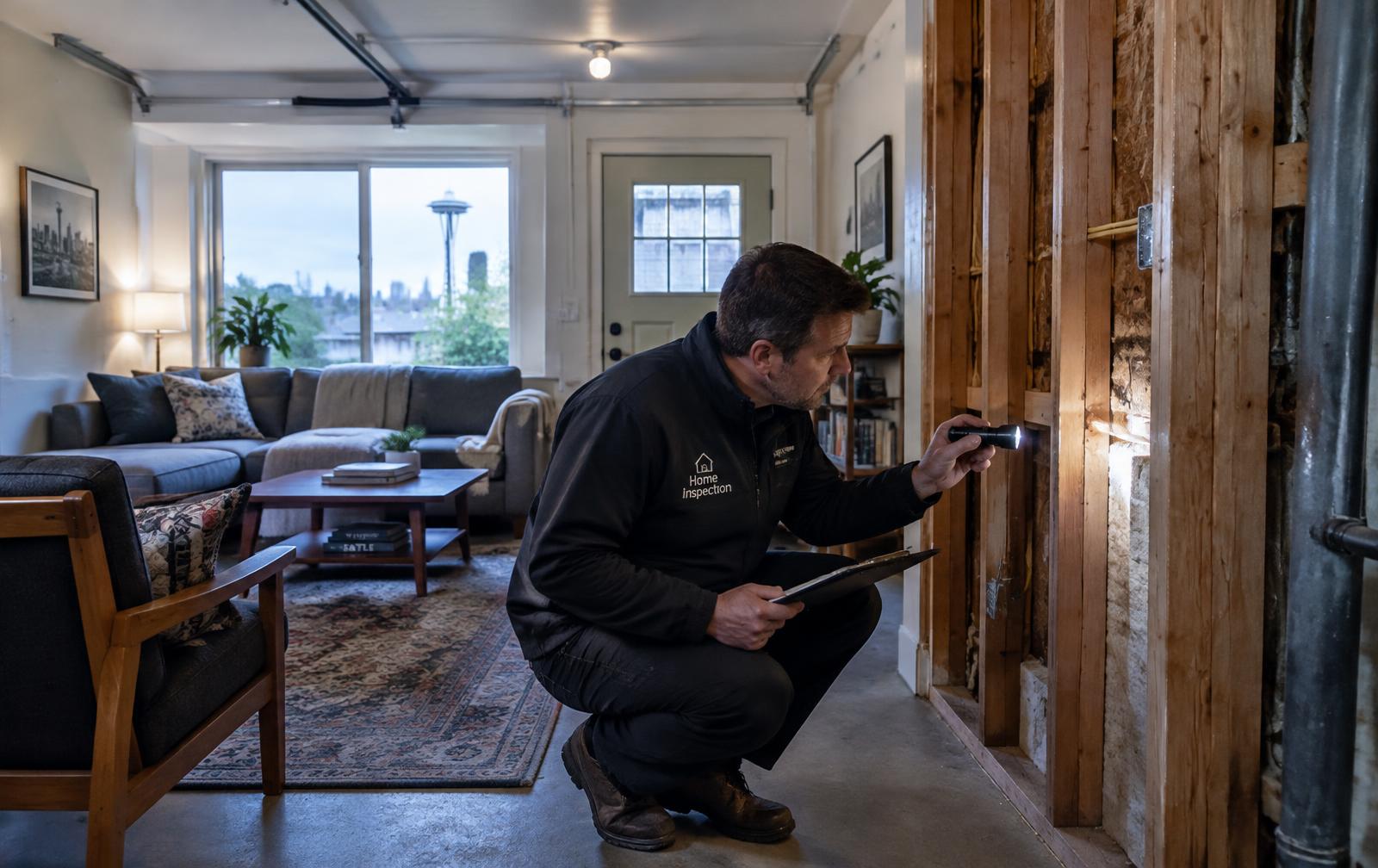
Three inspections do more to protect a Seattle buyer's budget than anything else: a sewer scope on any older home, a drainage and crawl-space review, and a roof assessment with a stated remaining life. Older housing stock is common inside the city, and issues found in any of these can be costly to remedy. Seismic considerations matter too, particularly for unreinforced older structures and homes on slopes. Whether an inspection finding lets you renegotiate or exit the contract depends entirely on the contingencies in your specific purchase and sale agreement — review those terms with your agent before you waive any contingency.
A decision method: does this specific home fit your budget
A worksheet is only useful if you also have a rule for reading it. The method we use with clients is straightforward: complete the worksheet above for the specific address, then compare that total against a ceiling you set before you started touring, not against a number that feels acceptable once you already love the house. Emotional attachment to a specific kitchen or view is a common reason buyers quietly raise their own ceiling mid-search, and it can leave the maintenance reserve line aspirational rather than real.
Once you have the worksheet total, run it three ways. First, as a share of gross monthly household income — many lenders and financial planners want total housing cost, including lines lenders do not always underwrite like maintenance, to stay within a range you can sustain through a slower income year; talk to your own lender and a financial advisor about what range fits your situation. Second, against your rent alternative, using the full worksheet total rather than principal and interest, since that is the comparison that actually tells you whether ownership is cheaper or simply different. Third, against a second candidate property in a different sub-market or property type, because a worksheet built for only one address cannot tell you whether that address is a good deal relative to its alternatives. For neighborhood-level context, see our Bellevue area guide.
If the total clears your ceiling only when you assume the low end of every range — the cheapest insurance quote, the smallest maintenance reserve, no allowance for a second-year tax jump — treat that as a signal, not a pass. A worksheet that only works under best-case assumptions is not a worksheet you can live with.
Common mistakes buyers make with the worksheet
The most common mistake is treating the listing page's estimated tax and estimated payment as final numbers rather than placeholders. Listing aggregators frequently display a prior year's tax bill or a generic calculation that has no relationship to your actual loan terms. The fix is mechanical: pull the parcel record yourself from the King County property tax search and get an actual lender quote before you get emotionally invested in a specific home.
The second common mistake is quoting insurance from a national average rather than a bound, address-specific quote — the property tax and insurance traps are detailed above in the line-by-line section, and both belong on the worksheet, not in a separate mental estimate.
The third mistake, specific to condos, is treating a low HOA due as a strictly good sign without checking whether a special assessment (worksheet line 6) is likely. Skipping the reserve study because the resale certificate package is long and unglamorous is exactly how a buyer inherits someone else's deferred maintenance.
A fourth, quieter mistake is building the maintenance reserve as an afterthought rather than a real monthly transfer, as covered above. Automating the transfer the same month you close is the single easiest fix on this list.
How different buyer profiles use this worksheet
A first-time buyer typically has the least room for error on the maintenance and insurance lines, because there is no prior home sale providing a cash cushion. For this profile, we spend the most time on the second-year tax scenario and on getting a bound insurance quote early. See our buyer resources for a fuller walkthrough of the purchase process.
A move-up seller who is also buying carries a different risk: bridging the closing dates on two transactions, and often assuming their new maintenance reserve will resemble their old home's, which is rarely true if the new home is older, larger, or in a different micro-climate for drainage exposure. What we tell move-up clients is to rebuild the worksheet from zero for the new address rather than adjusting the old one by a rough percentage; see our seller resources for the selling side of that timeline.
An investor evaluating a rental property needs the same worksheet, plus vacancy allowance and property management if applicable, and should be more conservative on the maintenance reserve than an owner-occupant would be. See our investment resources for more. A cross-border or relocating buyer should pay particular attention to the insurance and tax lines, since both can differ meaningfully from what is typical in other states or countries, and neither line behaves the way general online calculators assume.
Execution timeline: when to gather each number
Before you tour, get a lender pre-approval and ask specifically how they will treat any variable income, and whether mortgage insurance will apply to your loan, since that shapes your ceiling before you look at a single house. During touring, pull the parcel tax record for any address you seriously consider, and note whether recent improvements suggest a second-year jump.
During your inspection window — the period defined by the contingencies in your specific purchase and sale agreement — request a bindable insurance quote and, for condos, read the full resale certificate and reserve study rather than skimming the dues figure, and ask directly about any planned special assessment.
At or just before closing, confirm your prorated share of property tax and HOA dues, and set up the automated monthly transfer for your maintenance reserve so it starts with your first mortgage payment rather than being added later. In the weeks after closing, request the seller's utility history if you have not already, and true up your worksheet against your first two or three actual bills so your ongoing budget reflects reality rather than estimates.
FAQ
How much should I budget for maintenance?
Set the reserve against replacement cost and house age rather than purchase price, and increase it for older roofs, older systems and homes with drainage exposure. The point is that it is a scheduled monthly transfer, not an emergency.
Is the listing page's tax estimate reliable?
No. It is frequently a prior-year figure and it does not reflect improvements assessed after the last cycle. Pull the parcel record from the King County property tax search.
Does the buyer pay REET in Washington?
No. REET is a seller-paid excise tax on the sale price, tiered by price band, generally in the roughly 1.1% to 3.0% range per WA DOR. Buyers pay lender, title, escrow and prepaid items.
Should I compare this total against rent?
Yes, and against a second property. Comparing a mortgage payment against rent understates ownership cost by leaving out several of the worksheet's other lines.
Will my monthly payment always stay the same?
Only the principal-and-interest portion of a fixed-rate loan stays level. Adjustable-rate mortgages can reset, and if your servicer escrows taxes and insurance, your total payment will change whenever those amounts change — do not add lines 2 and 3 separately if they are already escrowed into your payment.
What our team is seeing
Stated as a team view rather than a statistic: the ownership budgets that run into trouble in year two often trip on the same two lines — a first-year tax bill on new construction, and an insurance quote that was estimated rather than bound. Both are addressable inside the inspection window, subject to the contingencies actually written into the contract.
On condos, we read the reserve study before we read the dues figure. Associations with funded reserves and completed envelope work tend to be a safer hold than a low monthly due with an unfunded envelope project — the special assessment line on the worksheet exists precisely to force that comparison before you make an offer, not after.
About the author
Maggie Sun, Managing Broker — Maggie became a licensed real estate agent in 2022 and leads the Bellevue-based bilingual team she founded in 2014, advising buyers, move-up sellers and investors across Bellevue, Seattle and the Eastside in English and Mandarin. For more on working with the team, see our contact page.
Last updated: September 2026. Market figures are sourced as listed under Sources below. This article is general information and is not legal, tax or investment advice; consult a licensed professional about your specific situation.
Sources
- King County Assessor — parcel records, levy rates by tax code area, via the property tax search tool
- King County Board of Equalization — property tax assessment appeals
- Washington State Department of Revenue (WA DOR) — REET rate tiers, property tax levy limits
- Seattle City Light and Seattle Public Utilities — utility rate schedules
- WA Office of the Insurance Commissioner — homeowners insurance guidance
- CFPB Owning a Home and CFPB: what is private mortgage insurance
- NWMLS — closed sales used for comparable property selection
- Team transaction experience — inspection and insurance outcomes
This article is general information based on public data and our team's transaction experience. It is not legal, tax, appraisal or investment advice. Verify every figure for your own address, property type and tax situation before you act.