
Fact and link review: September 22, 2026
A useful market guide does not promise appreciation or reduce Redmond to one median price. It shows buyers which local signals matter for a specific property and decision window.
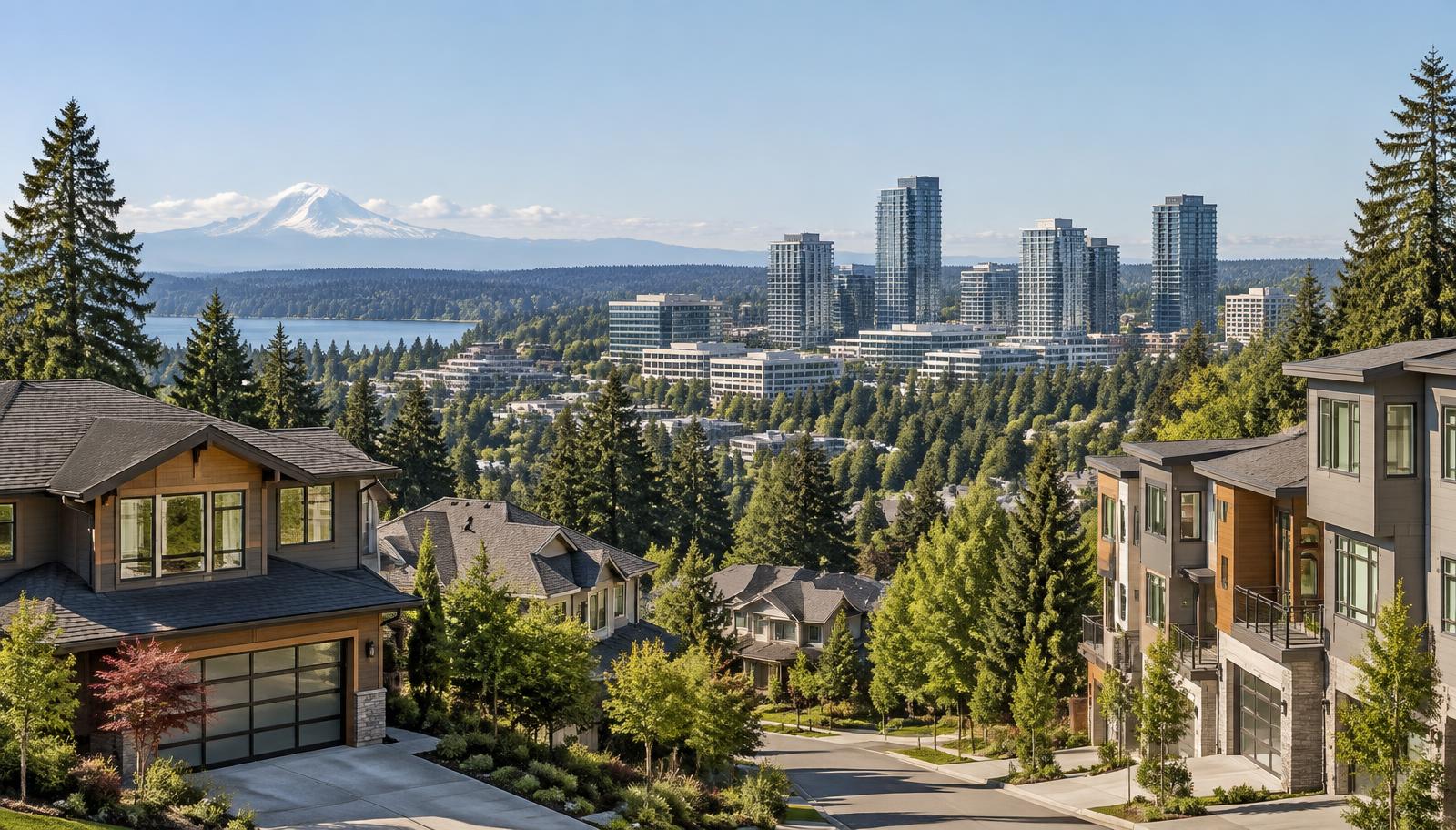
Concept illustration (not an actual listing, bill, market statistic, or return claim): Topic image: Redmond combines distinct housing types, employment centers, transit, and neighborhood conditions.
Start with the property type, not the headline
A citywide figure can mix detached homes, townhomes, and condominiums with different price ranges and buyer pools. Before interpreting any trend, identify the property type, neighborhood, price band, and date range. A single median or "average days on market" number for "Redmond" tells you almost nothing about a specific 3-bedroom detached home in a specific micro-neighborhood if that number blends new-construction townhomes, older single-family resales, and downtown condominiums together.
For an offer decision, recent comparable sales and current competing listings are more useful than a broad annual headline. For a move-timing decision, months of supply and days on market can provide context—if calculated consistently, using the same property type and boundary each time.
What a publishable current snapshot must include
This review draft does not insert an unverified Redmond statistic. A current snapshot is publishable only when it states the month, Redmond boundary, property type, price band, source, sample size where available, and extraction date. A broker should refresh those fields from NWMLS immediately before publication; otherwise this page should remain a data-reading guide rather than claim to be a current market report.
| Required field | Publishable format |
|---|---|
| Period | Named month and year, plus comparison period |
| Geography | Defined Redmond area; not a mailing ZIP by itself |
| Property type | Detached, townhome, or condominium reported separately |
| Indicators | Active/pending/closed count, median, days on market, sale-to-list ratio |
| Source and pull date | NWMLS report and the date the report was generated |
Five indicators buyers should request
| Indicator | What it can show | What it cannot prove |
|---|---|---|
| Active and pending listings | Current choice and near-term competition | Future prices |
| Recent comparable sales | Evidence for a specific value range | Value without condition adjustments |
| Days on market | Market pace for a defined segment | Seller motivation by itself |
| Sale-to-list ratio | How pricing performed in that sample | A required offer strategy |
| Price changes and relists | Possible resistance to initial pricing | The property's condition or defects |
None of these indicators works well alone. A short days-on-market figure with a high sale-to-list ratio in a narrow, recent sample suggests active competition in that segment; the same figure paired with several price reductions elsewhere can point to a market that is inconsistent by price point. Ask for the underlying data, not just a summary conclusion.
It also matters who is producing the figures. NWMLS-sourced data reflects actual local listing and closing activity, filtered to your target area and property type. Broader portals sometimes aggregate differently, so when two sources disagree, ask which boundary and date range each one used.
Reading Redmond's listing cycle through the year
Like much of the Puget Sound region, new listing volume in Redmond tends to follow a seasonal pattern rather than staying flat all year, though the exact timing and intensity can shift from year to year. A general, non-numeric way to think about the pattern:
- Early in the year: inventory is often thinner as fewer sellers have listed yet; buyers researching during this window may see fewer active choices but also less new competition arriving daily.
- Spring into early summer: new listings typically increase, giving buyers more selection, but also often drawing more buyer activity into the market at the same time.
- Late summer into fall: pace can moderate as school schedules and other commitments reduce showing availability for both buyers and sellers.
- Holiday season: listing volume commonly slows further; sellers who do list during this period may be more motivated, but this is not guaranteed and should be verified case by case.
This pattern is a general seasonal tendency, not a forecast for any specific year, price band, or property type—verify current activity with dated, filtered data before making a timing decision.
Redmond and Bellevue are not interchangeable comparisons
Redmond and Bellevue can serve different daily routines, housing preferences, and price bands. Compare actual candidate homes rather than declaring one city a universal better investment. Include commute destinations, property age, lot, HOA obligations, and access to services.
Transit and road conditions change over time. Test the route at the hours the household will use it and review official project information rather than relying on a single map estimate.
It is also worth separating "which city" from "which neighborhood." Redmond contains distinct areas, and some nearby unincorporated pockets may carry a Redmond mailing address without being inside city limits. Confirm actual jurisdiction with the King County Assessor parcel record rather than assuming the mailing address settles the question.
Comparing housing types: a side-by-side framework
Buyers often ask whether a detached home, a townhome, or a condominium is the "better" choice in Redmond. There is no universal answer; the right fit depends on budget, maintenance preference, and how the buyer plans to use the property. The table below outlines factors to weigh for each type—these are general considerations, not a ranking, and they should be checked against the specific property under review.
| Factor | Detached home | Townhome | Condominium |
|---|---|---|---|
| Land ownership | Typically includes the lot | May include a small lot or shared land | Usually no direct land ownership; shared common elements |
| HOA/association review | Sometimes none, sometimes a community HOA | May or may not use a condominium form of ownership; verify title, declaration, CC&Rs, budget, and reserves | Almost always a condo association; review budget, reserves, and litigation history |
| Exterior maintenance | Owner's responsibility | Responsibility varies; verify roof, exterior, party wall, drainage, and insurance in the governing documents | Typically handled by the association |
| Financing considerations | Standard for most lenders | Generally standard, verify HOA insurance | Financing review depends on legal ownership form and association documents |
| Resale pool | Broad, but depends on price band | Depends on local demand for attached housing | Depends on financing eligibility and buyer preferences at resale time |
Before writing an offer on a townhome or condominium, request the HOA or association's governing documents, current budget, reserve study, and any pending special assessments or litigation.
School boundaries require an address check
A Redmond mailing address does not guarantee one school assignment. School boundaries may cross city and ZIP-code expectations, and assignments can change. Use the official district locator for the exact address and verify again before relying on it in a purchase decision.
Adjacent homes on the same street may be assigned to different schools, and boundaries are periodically redrawn as enrollment shifts. Verify directly with the Lake Washington School District's boundary lookup tool using the exact parcel address, and consider re-verifying closer to closing if there is a significant time gap. Avoid relying on a portal's "school rating" badge as a substitute for boundary verification.
Ownership cost components buyers often underestimate
Purchase price is only one part of the cost of owning a home in Redmond. The following is a general framework of cost categories to budget for, not a prediction of any dollar amount—actual figures vary by property, lender, and insurer and must be obtained directly from the relevant party.
- Property taxes: assessed by King County based on the parcel's assessed value; request the current tax bill from the King County Assessor rather than assuming a percentage rule of thumb.
- Homeowners or condo insurance: obtain a quote for the specific property; older construction, roof age, and claims history can affect availability and premium.
- HOA or condo dues: confirm the current amount, what it covers, and whether a special assessment is pending or has recently been approved.
- Utilities and service connections: ask whether the property is on public sewer or a septic system, and confirm the water and stormwater utility provider serving the address.
- Maintenance reserve: for detached homes especially, budget for roof, HVAC, and exterior maintenance that an association would otherwise cover for a condominium.
- Loan-related costs: ask your lender for a current loan estimate covering interest rate, points, lender fees, and mortgage insurance if applicable.
Illustrative example only (not a market figure): a buyer can build a simple monthly ownership worksheet using an assumed tax percentage confirmed with the assessor, a hypothetical insurance quote, and an assumed HOA due, then replace each assumed number with a verified figure once a specific property is identified.
How to read an offer environment
- Ask how many offers are registered, but do not treat an agent's estimate as a guarantee.
- Review comparable sales with adjustments for condition, location, lot, parking, and HOA.
- Choose inspection and financing terms based on your risk tolerance; do not assume a pre-inspection makes waiver risk-free.
- Set an appraisal-gap limit only after understanding available cash and lender requirements.
- Keep the maximum price tied to the property, not to the number of competing offers.
A useful discipline is to write down your maximum price and walk-away conditions before you see the competing offer count. Adjusting a price based on new comparable-sale evidence is reasonable; adjusting it purely because of a competing-offer count without new value evidence is a decision worth pausing on. It can also help to ask the listing agent what terms the seller values most—closing flexibility or financing certainty can matter as much as price.
Common mistakes buyers make when reading a market
- Treating a national headline as local fact. National coverage of rates or broad trends does not describe a specific Redmond property type; ask for local, dated, filtered data.
- Comparing listings across seasons without adjusting. A comparable sale from months ago in a different season may not reflect current conditions.
- Assuming a ZIP code equals a school or city boundary. As noted above, none of these three boundaries reliably match.
- Skipping HOA or condo document review under time pressure. Financing and cost can be affected by issues invisible in listing photos.
- Confusing FIRPTA withholding with a "foreign buyer tax." FIRPTA is a federal withholding and reporting obligation on the buyer/transferee when purchasing from a foreign seller—not a tax on foreign buyers. Confirm applicability with a tax professional.
- Assuming Washington's capital gains tax applies to real estate. As structured, it does not apply to real estate transactions.
- Anchoring on a single online valuation estimate. These tools are a starting reference, not a substitute for a broker's comparable-sale analysis.
Due diligence for remote and relocation buyers
Remote buyers should separate digital signatures, notarization, wire delivery, inspection attendance, and final walkthrough. These are different steps and may not all be completed through the same remote process.
- Use live video to review road noise, grade, drainage, light, and surrounding uses.
- Confirm title exceptions, permits, sewer or septic status, and HOA documents as applicable.
- Verify wire instructions through a known escrow contact; email alone is not sufficient.
- Arrange for a trusted local representative to attend the in-person inspection and final walkthrough if you cannot travel.
- Ask your escrow company about remote online notarization and which documents still require in-person signing.
Relocation buyers should ask their broker and inspector to explain Pacific Northwest-specific concerns such as drainage, moisture management, and heating system type.
Who does what: buyer and agent responsibilities
A clear division of labor reduces confusion during a transaction. The following is a general framework; actual responsibilities are set by the specific representation agreement and purchase contract.
| Task | Typically the buyer's responsibility | Typically the agent's or broker's responsibility |
|---|---|---|
| Setting budget and financing pre-approval | Yes, with lender coordination | Can refer lenders; does not approve loans |
| Comparable-sale analysis | Reviews and asks questions | Pulls and explains data from NWMLS |
| Inspection and repair negotiation strategy | Makes final decisions | Coordinates inspectors and advises on options |
| School boundary verification | Confirms for the specific address | Can point to the official district tool |
| HOA/condo document review | Reads and asks questions; may involve an attorney | Requests documents from listing side |
| Tax and legal questions (e.g., FIRPTA, entity purchases) | Engages a CPA or attorney | Flags the issue; does not give tax or legal advice |
Frequently asked questions
Is Redmond a buyer's or seller's market?
It depends on the current segment and week. Request dated figures for the relevant property type and price range rather than a citywide label.
Should I waive inspection because homes move quickly?
No universal rule applies. Waiving contingencies changes risk; discuss consequences before deciding, and treat a pre-inspection as a partial, not complete, substitute.
Does a short Microsoft commute guarantee resale value?
No. Employment, transportation, condition, supply, schools, and preferences can all change over time.
Do I need a Redmond-based agent, or can any Eastside broker help?
Direct, recent experience in the specific area matters more than office location alone.
Is FIRPTA a tax on foreign buyers?
No. It is a federal withholding and IRS reporting requirement generally applying to the buyer/transferee when purchasing from a foreign seller. Confirm specifics with a tax professional.
Will I owe Washington capital gains tax if I sell my Redmond home?
As currently structured, the state capital gains tax does not apply to real estate sales. Confirm your situation with a CPA, since other taxes may apply.
How much should I budget for closing costs?
There is no fixed percentage; ask your lender and escrow company for a current, itemized estimate for your loan program and property.
Can I rely on an online home value estimate to set my offer price?
It is a starting reference point, not a substitute for a broker's comparable-sale analysis accounting for condition and micro-location.
Sources
- NWMLS — local listing and closed-sale data; property-specific reports should state period and property type
- King County Assessor — parcel characteristics and assessed-value records
- Lake Washington School District — official address-based school boundary lookup
- Sound Transit — Eastside transit project information
- IRS — FIRPTA Withholding — official explanation of buyer/transferee withholding obligations
- Washington State Department of Revenue — Capital Gains Tax — official scope of the state capital gains tax
This article is general information, not legal, tax, lending, or investment advice. Verify parcel taxes, school boundaries, financing terms, and investment assumptions with the relevant official agency and licensed professional before acting.