

Condos for Sale in Bellevue, WA: What Buyers Should Know in 2026
Searching for condos for sale in Bellevue, WA usually starts with photos and prices. But the better question is, “What am I really buying into?” A condo is both a home and a building community. HOA fees, reserves, rental rules, financing, and resale risk all matter. This guide helps you compare Bellevue condos with buyer eyes, not just listing-page eyes.
Is Buying a Condo in Bellevue a Good Idea?
Buying a condo in Bellevue can be a smart move if you want location, convenience, and lower exterior maintenance. It may not fit you if you want land, full control, or fewer shared decisions; this Bellevue home buying guide gives broader buying context.
Bellevue Condo May Be a Good Fit If... | A Condo May Not Be the Best Fit If... |
You want Downtown Bellevue access | You need a private yard |
You want less exterior maintenance | You dislike HOA rules |
You are a first-time buyer | You want full renovation control |
You are downsizing | You need more storage |
You want a lock-and-leave lifestyle | You want short-term rental flexibility |
You value elevators, parking, or amenities | You worry about HOA increases |
Where to Find Condos for Sale in Bellevue, WA

The best Bellevue condo area depends on your lifestyle, commute, and budget. Start with neighborhood fit, then compare buildings; this Bellevue neighborhood guide can help.
Downtown Bellevue is usually a strong fit for buyers who want walkability and luxury buildings, but buyers should pay close attention to higher HOA fees. West Bellevue may appeal to buyers who want a premium location and lake access, though inventory can be limited. Wilburton and BelRed may work well for buyers watching transit access and redevelopment, but construction changes and future density should be considered. Crossroads and East Bellevue can be practical for daily convenience, especially for buyers comparing older buildings and HOA condition. Factoria may offer commuting convenience and relative value, but resale demand and building condition still matter.
Wilburton and BelRed may get more attention after the 2 Line Crosslake Connection opened on March 28, 2026 (Source: Sound Transit, 2026).
How Much Do Bellevue Condos Cost in 2026?
Bellevue condo prices vary by area, building age, view, parking, and HOA quality. Downtown Bellevue gives the clearest reference point, and this Downtown Bellevue real estate guide adds local context.
Cost / Price Item | 2026 Reference Point |
Downtown Bellevue median sale price | $894,500 (Source: Homes.com, 2026) |
Downtown Bellevue one-bedroom condo range | From about $550,000 (Source: Homes.com, 2026) |
Downtown Bellevue multi-bedroom or penthouse range | Up to about $3 million (Source: Homes.com, 2026) |
One-bedroom Downtown Bellevue HOA fees | About $600-$900/month (Source: NWMLS/Redfin, 2026) |
Two-bedroom Downtown Bellevue HOA fees | About $800-$1,200/month (Source: NWMLS/Redfin, 2026) |
Luxury Downtown Bellevue HOA fees | About $1,200-$2,000/month (Source: NWMLS/Redfin, 2026) |
Penthouse-level HOA fees | $2,000+/month (Source: NWMLS/Redfin, 2026) |
Bellevue estimated effective property tax rate | About 0.71% (Source: Ownwell, 2026) |
Estimated annual tax on $1M | About $7,100/year (Source: Ownwell, 2026) |
Estimated annual tax on $2M | About $14,200/year (Source: Ownwell, 2026) |
What Monthly Costs Should Bellevue Condo Buyers Expect?
Bellevue condo buyers should expect more than the mortgage payment. Taxes, HOA fees, insurance, utilities, parking, and assessments all shape the real budget; this Bellevue cost of living guide adds useful context.
Example below assumes a $1,000,000 Bellevue condo. It also assumes 20% down, a 6.75% interest rate, and Downtown Bellevue-style HOA fees.
Monthly Cost | Example Cost | Why Buyers Notice It |
Mortgage principal and interest | About $5,190/month | Based on an $800,000 loan at 6.75% |
Property tax | About $592/month | Based on about $7,100/year on a $1M property |
HOA fees | About $800-$1,200/month | Common for many two-bedroom Downtown Bellevue condos |
Condo insurance | About $50-$100/month | Depends on coverage and master policy |
Utilities | About $100-$250/month | Some utilities may be included in HOA dues |
Parking / storage | $0-$200+/month | May be included, deeded, rented, or separate |
Move-in fees | One-time or building-specific | Common in managed condo buildings |
Future assessments | Not monthly, but possible | Depends on reserves, repairs, and HOA condition |
In this example, a $1M Bellevue condo could carry about $6,700-$7,300 per month. That is before any future special assessments.
A higher HOA fee is not always bad. It may include water, garbage, insurance, security, elevators, reserves, and amenities.
A low HOA fee is not always good. It may mean the building is under-saving for repairs.
What Is a Special Assessment in a Condo Purchase?
A special assessment is an extra charge owners pay beyond regular HOA dues. It usually appears when the building needs money for repairs, reserves, insurance, or legal issues; avoiding this is one of the common home buying mistakes.
Washington’s common-interest law covers budgets, assessments, reserves, and resale certificates under RCW 64.90 (Source: Washington State Legislature, 2026).
Special assessments may happen because of weak reserve funds, roof repairs, elevator repairs, plumbing issues, siding or window replacement, garage repairs, insurance premium increases, deferred maintenance, safety updates, pending litigation, amenity repairs, or capital project overruns.
Before making an offer, buyers should review the resale certificate, HOA budget, reserve study, meeting minutes, seller disclosure, pending repair notices, litigation disclosures, and special assessment history.
Can You Rent Out a Condo in Bellevue?

Yes, you can rent out some Bellevue condos, but only if the building allows it. Rental rules usually come from HOA documents, not just city rules; this living in Bellevue guide gives lifestyle context.
Buyers should check rental caps, rental waitlists, minimum lease terms, short-term rental restrictions, tenant registration rules, move-in and move-out fees, and owner-occupancy rules.
This matters even if you plan to live there. A job move can turn today’s home into tomorrow’s rental.
A condo may look like a great investment on paper. But a rental cap can block your plan.
Why Condo Financing Can Be More Complicated
Condo financing can be harder because lenders review the building too. You may qualify as a buyer, but the condo project may still raise concerns; this Bellevue real estate investment guide explains broader risk.
Fannie Mae project standards include project finances, marketability, owner control limits, and project-level litigation (Source: Fannie Mae, 2026).
Building-level issues that can affect financing include insufficient HOA reserves, pending litigation, active or upcoming special assessments, high rental concentration, weak master insurance, deferred maintenance, HOA delinquency issues, structural concerns, and missing project documents.
This also affects resale. If fewer buyers can get loans, your future buyer pool may shrink.
How HOA Rules and Building Health Affect Resale Value
HOA rules and building health affect resale because future buyers review the same documents. Problems you ignore today may become buyer objections later; this Bellevue housing market guide helps frame local demand.
Resale risks can include high HOA fees, weak reserves, pending litigation, strict rental caps, active assessments, poor maintenance, limited loan options, and negative building reputation.
Investors care about rental flexibility. Owner-occupants care about monthly cost and building condition.
Both groups care about confidence. A clean HOA file can make a condo easier to sell.
How to Compare Bellevue Condos Before Making an Offer

Do not compare Bellevue condos by price alone. Compare the unit, building, HOA, rules, financing, and exit plan before you offer; this Bellevue buyer checklist can help.
Start with the unit condition, including layout, light, noise, view, and appliances. Then review parking and storage, including whether the space is deeded, rented, assigned, or shared.
Monthly cost should include the mortgage, property tax, HOA fees, insurance, utilities, parking, and possible future assessments. HOA finances also matter, so buyers should review the budget, reserves, and delinquency rate.
Building condition should be checked carefully, including roof, siding, elevators, and plumbing. HOA rules should also be reviewed for rentals, pets, renovations, and move-ins. Legal risk, including litigation, claims, and owner disputes, can affect both financing and resale.
Buyers should also confirm financing options, including FHA, VA, and conventional review. Location factors such as commute, light rail, groceries, and schools still matter, but resale should be considered too. Demand, rental flexibility, and building reputation can all affect your future exit.
Should You Buy a Condo or a House in Bellevue?
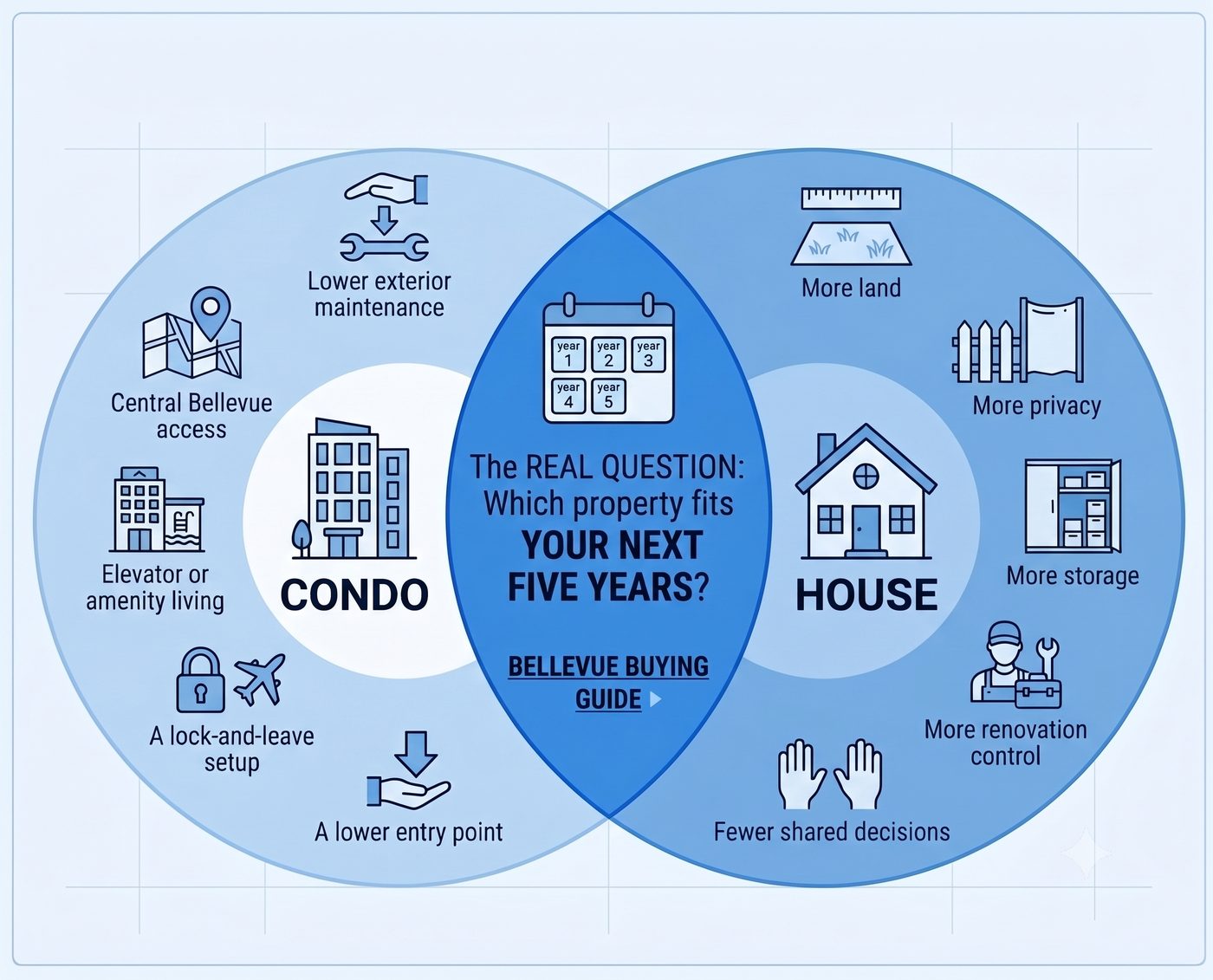
A condo may fit better if you want location, convenience, and lower exterior maintenance. A house may fit better if you want land, privacy, storage, and control; this Bellevue buying guide can help frame the choice.
Choose a condo if you want lower exterior maintenance, central Bellevue access, elevator or amenity living, a lock-and-leave setup, or a lower entry point.
Choose a house if you want more land, more privacy, more storage, more renovation control, and fewer shared decisions.
For many buyers, the real question is not condo or house. It is which property fits your next five years.
Buying a Bellevue condo starts with listings. The real work starts with the building behind the listing. Compare location, monthly cost, HOA health, rental flexibility, financing, and resale risk. A good condo should still make sense after you read the documents. For help comparing Bellevue condos, connect with Maggie Real Estate Group now.
FAQ
Are condos in Bellevue cheaper than houses?
Yes, condos often have a lower entry price than Bellevue houses. But the long-term cost depends on HOA fees, taxes, repairs, and assessments.
Can HOA fees go up after I buy?
Yes, HOA fees can increase after closing. Insurance, labor, repairs, utilities, and reserve funding can all push dues higher.
Is a condo inspection still needed?
Yes, a condo inspection is still useful. It can reveal interior issues, water damage, window problems, and appliance concerns.
Can I use an FHA or VA loan on a Bellevue condo?
Yes, but only if the building and loan program allow it. Ask your lender to check condo eligibility early.
What happens if I do not pay a special assessment?
No, you should not ignore a special assessment. The HOA may charge late fees or place a lien, depending on the documents and law.
Do all Bellevue condo buildings have rental restrictions?
No, rental rules vary by building. Always check the CC&Rs, bylaws, rules, and resale certificate.
How do I know if a condo building has litigation?
Yes, you can usually find clues in HOA disclosures. Review the resale certificate, meeting minutes, and seller disclosures.
Is a newer Bellevue condo always safer to buy?
No, newer does not always mean lower risk. You still need to review warranty issues, HOA setup, reserves, and building management.
Maggie Sun
Managing Broker | Buy, Sell & Invest Seattle & Bellevue | Maggie Sun Real Estate Group
or another way