

I. February 2026 Seattle Real Estate Market Report: Price Trends and Market Analysis
As we enter early 2026, a growing trend has emerged in Seattle's real estate market: home prices haven't declined significantly, but properties are staying on the market noticeably longer. Both buyers and sellers are asking the same question: Why do open houses still draw crowds when so many listings struggle to sell? At first glance, price data suggests market stability. However, when examining inventory, sales velocity, and buyer behavior together, we see structural shifts occurring. Seattle's current market resembles a "Frozen Market" rather than a traditional downturn.
For context on Seattle's housing market evolution in recent years, refer to our previous 2025 Seattle Housing Market Report. In other words, the market hasn't crashed—it's reached a delicate standoff between buyers awaiting better prices/rates and sellers with substantial equity who feel no urgency to reduce prices.
This report analyzes 2026's latest developments, including Seattle price trends, King County inventory, mortgage rate changes, and current strategies for buyers/sellers.
Key 2026 Seattle Market Metrics
Seattle's 2026 market has entered a "slower sales with stable prices" phase. Latest King County data shows:
-
Median price: ~$835,000 (YoY +1.8%)
-
Inventory: ~2.7 months
-
Average days on market: ~14
-
30-year fixed mortgage rate: ~5.98%
Overall, Seattle's market shows no sharp declines but has entered an adjustment phase with flat prices and slower transactions.
II. February 2026 Seattle Market Data
Let's examine King County's February 2026 metrics—key indicators revealing Seattle's true market conditions.These NWMLS statistics show 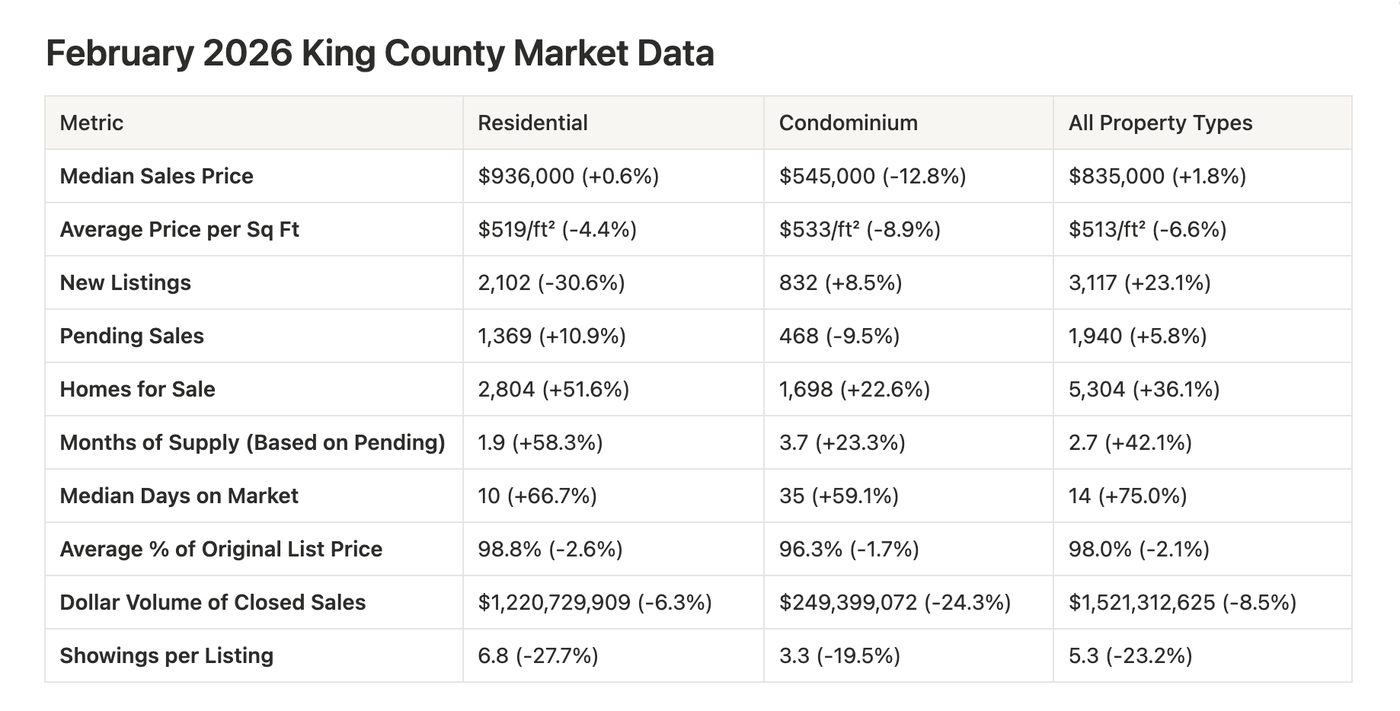
February 2026 Key Trends:
- King County median price: ~$835,000 (YoY +1.8%)
- Single-family homes stable; condos down ~13%
- Growing inventory: ~2.7 months supply
- Average days on market: 14
- 30-year fixed rate: 5.98%
In summary, early 2026 shows stable prices with declining sales volume.
1. Price Trends: Single-Family Stable, Condos Decline
NWMLS data shows King County's February 2026 median price at $835,000 (+1.8% YoY). While overall prices appear stable, segmentation reveals stark differences:
-
Single-Family Homes: Median ~$936,000 (flat YoY)
-
Condos: Median ~$545,000 (-13% YoY)
Price per square foot:
-
Single-family: -4%
-
Condos: -9%
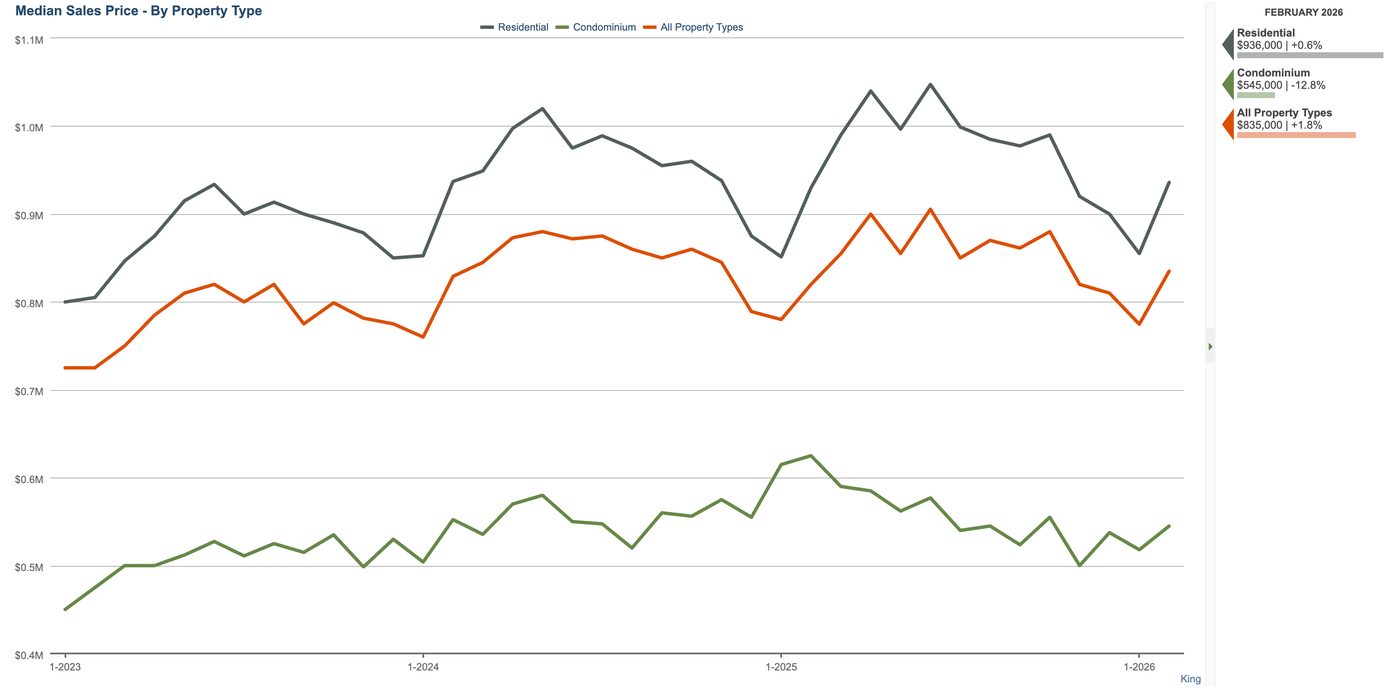
Notably, condos still command higher per-square-foot prices but are declining faster—indicating weakening demand. Single-family homes demonstrate stronger market support.
This divergence reflects Seattle's long-term trend: amid high prices/rates, buyers prioritize long-term assets like single-family homes or top-school districts over high-HOA condos.
2. Rising Inventory
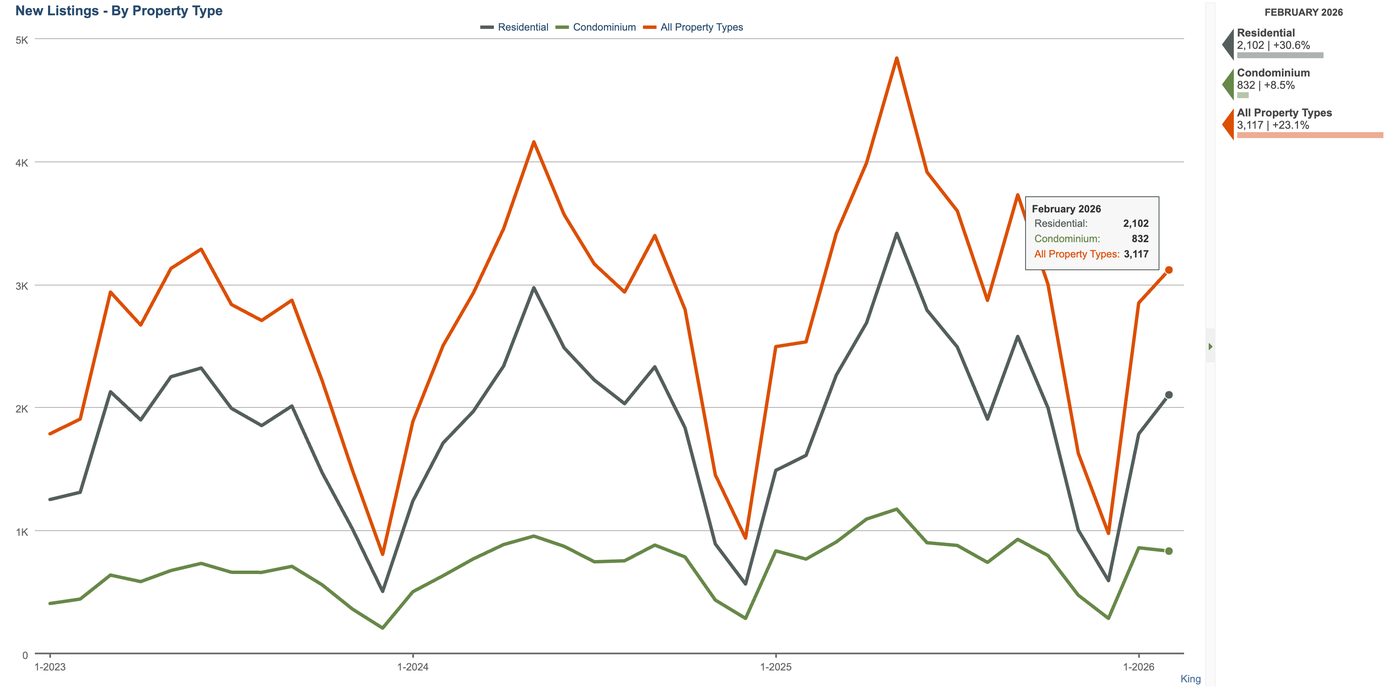
Inventory growth now outpaces demand. February 2026 data shows:
- New listings: +23% YoY
- Pending sales: +5.8% YoY
- Active listings: +33%+ YoY
Months of inventory: 2.7 (+40%+ YoY).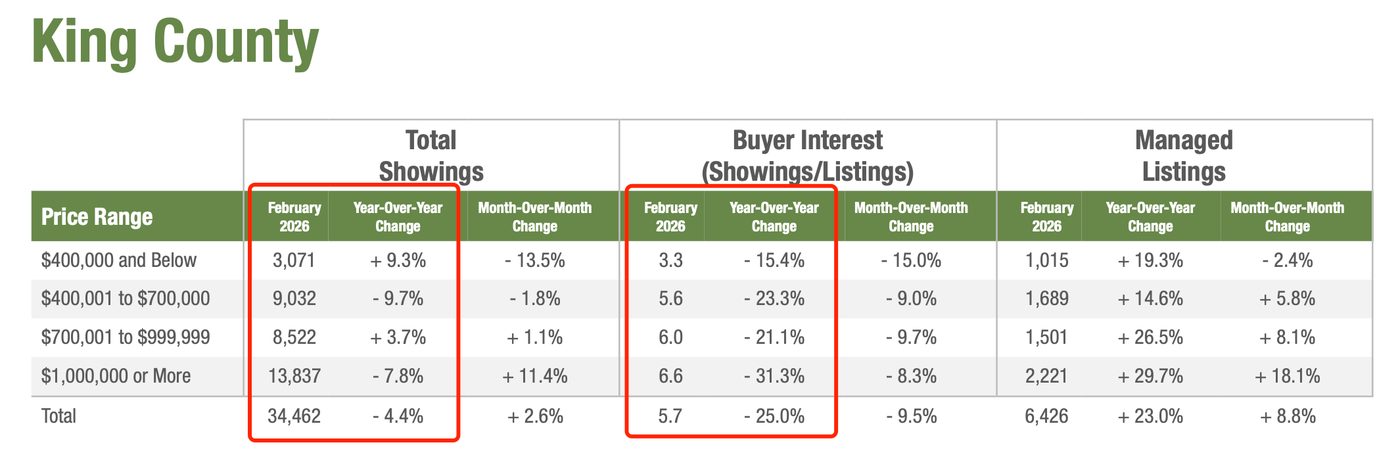
While still below the 6-month "buyer's market" threshold, inventory growth signals a shift from extreme seller's markets toward balance—increasing competition among sellers while giving buyers more options.
3. Slower Sales Velocity
February 2026's median days on market reached 14 (+75% YoY). Single-family homes average 10 days; condos exceed 35 days. ShowingTime data reveals 20%+ fewer showings YoY.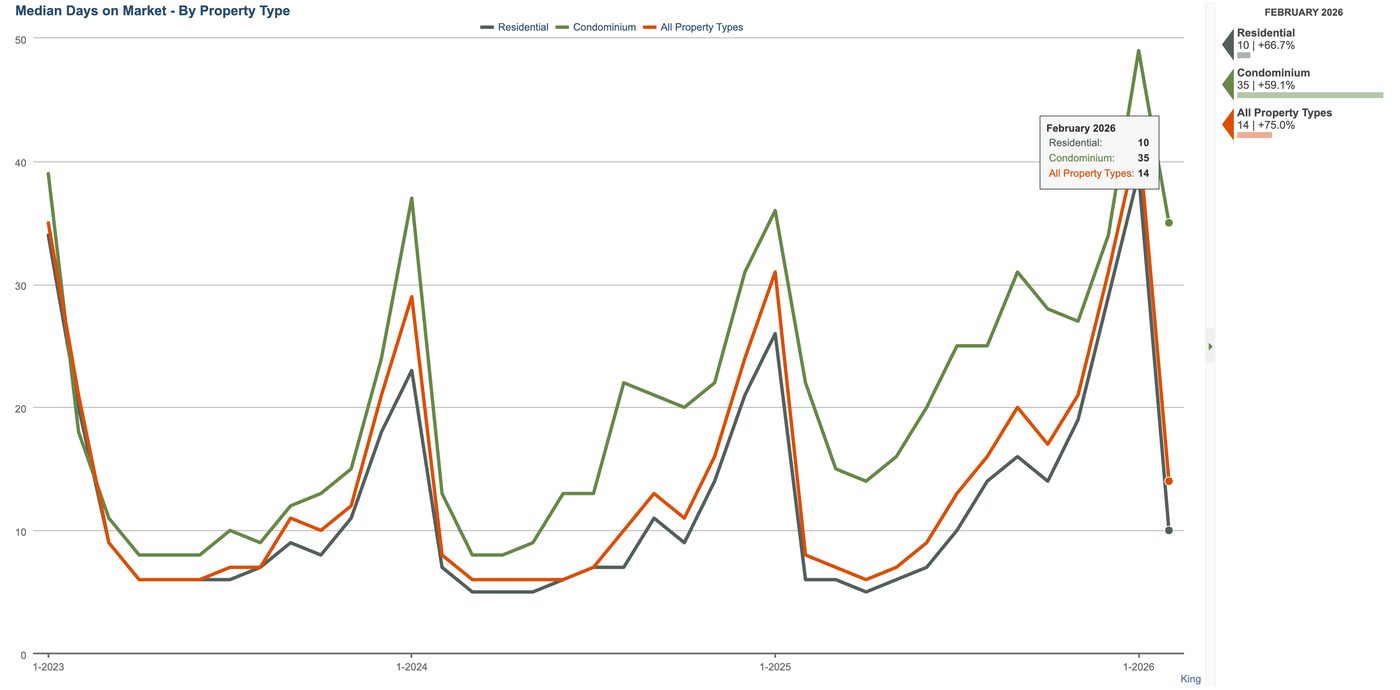
Fewer showings, longer marketing times, and slower sales collectively indicate cautious, deliberate buyer behavior—not absence of demand.
III. National Perspective: A "Frozen" Market
This trend mirrors national conditions. NAR reports 2024's 4.06M existing-home sales were the lowest since 1995.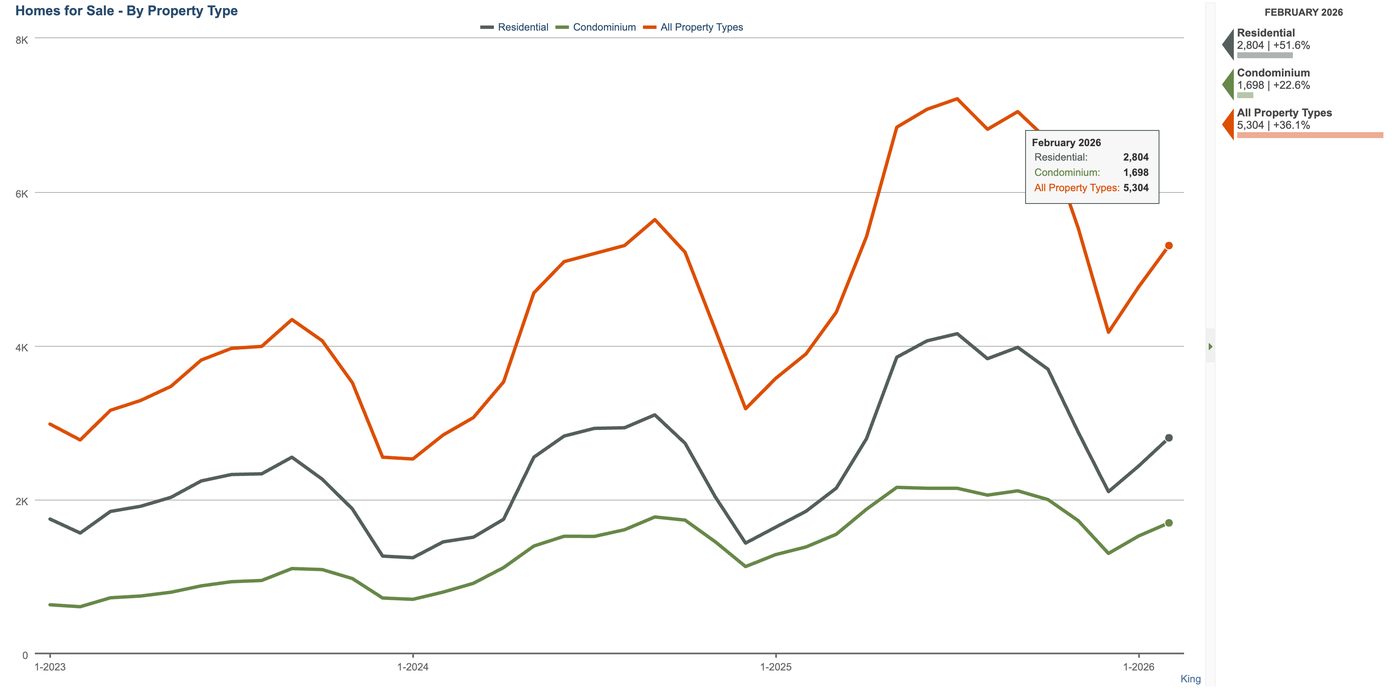
For comparison:
- 2005 peak housing market: ~7 million units
- 2021 pandemic market: ~6.12 million units
- 2024 decline to: ~4.06 million units
Despite significant drops in transaction volume, home prices remain at historic highs.
NAR Chief Economist Lawrence Yun noted a rare phenomenon in today's market: home prices hitting record highs while transaction volumes sit at historic lows.
This indicates the market isn't crashing but rather entering a transactional freeze.
Why home prices haven't dropped significantly
A key factor is homeowners' substantial equity positions.
ATTOM data shows Seattle's seriously underwater mortgages at just 1.3% - far below the national average (3%), Austin (6-7%), or some Florida cities (nearly 11%).
With most Seattle homeowners having ample equity, they face no pressure to sell at discounts. Many sellers opt to hold rather than reduce prices when expectations aren't met, explaining why prices remain stable despite lower sales volume.
IV. Rate Fluctuations: A Critical Market Signal
Interest rates remain a major housing market influencer.
Freddie Mac reports the 30-year fixed mortgage rate dropped to 5.98% as of February 26, 2026 - the first sub-6% reading in 3.5 years.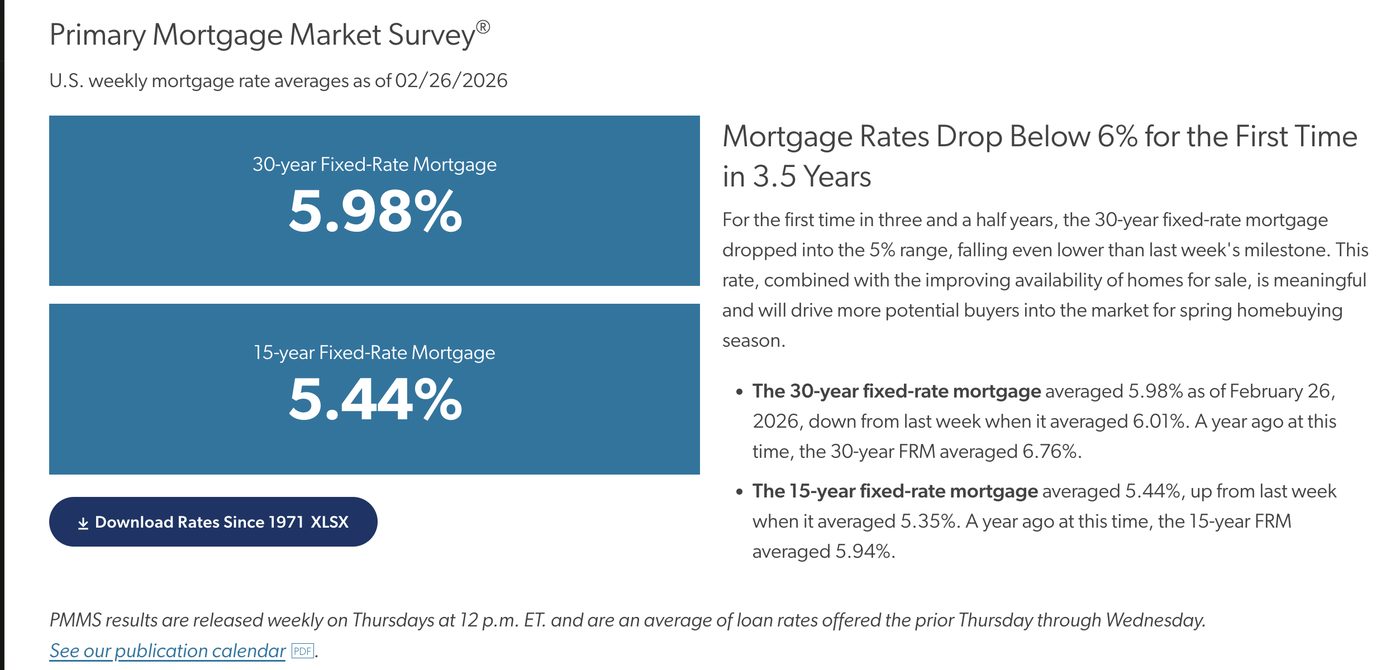
This 80-basis-point decline from last year's 6.76% crossed a psychological threshold for buyers, yet market re-entry hasn't surged. This confirms rates are just one factor among many in purchase decisions.
First-time buyers should understand loan processes, down payments, and purchasing costs beyond rate watching. Our Complete U.S. Home Buying Guide details the entire process.
V. Why More Buyers Are Choosing to Wait
Seattle's market shows growing buyer hesitation due to two core issues: declining affordability and renting's cost advantage.
1. Elevated Price-to-Income Ratio
Seattle's median home price ($830K-$840K) versus median household income ($124K) creates a 7:1 ratio - far above the healthy 3:1 benchmark.
At current rates, an $830K home carries $5,500-$6,000 monthly costs, requiring ~$220K annual income for safe affordability (30% income rule).
2. Renting Beats Buying
Seattle rents remain stable per Zumper and Rent.com 2026 data:
- 1-bedroom: $2,365
- 2-bedroom: $2,659
Owning a comparable 2-bedroom costs $4,200-$4,500 monthly (mortgage, taxes, insurance, HOA) - a $1,500-$2,000 premium over renting.
VI. Current Market Strategies for Buyers & Sellers
Opportunities exist despite slower markets - the key is strategic positioning.
1. Seller Advice: Pricing Precision Matters
Overpricing now risks buyer disinterest. Homes lingering beyond 30 days typically need ~5% price adjustments to regain attention.
2. Buyer Advice: Home Choice Trumps Timing
Rather than waiting for perfect conditions, target properties with:
- Outdated decor/poor photos (negotiation leverage)
- Avoid properties with:
- Structural issues (noise, lighting, foundation)
- Problematic HOAs
Budget-conscious buyers might explore nearby cities like Bellevue, Renton, or Everett. See our Affordable Cities Near Seattle guide for alternatives.
VII. Will Seattle Prices Drop in 2026?
While significant declines appear unlikely, upward momentum is limited. The market will likely enter a price stabilization phase rather than 2008-style corrections.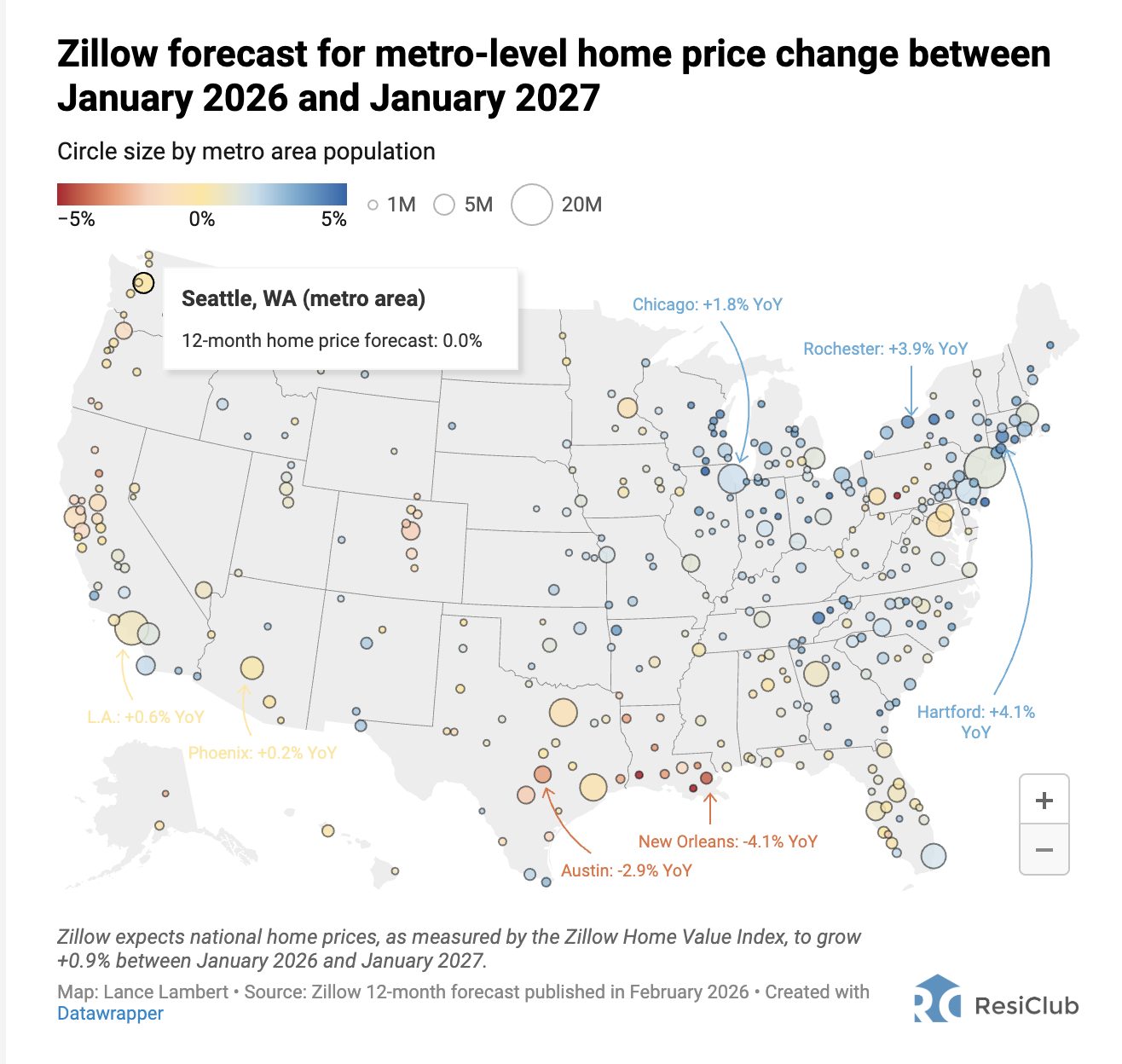
Three factors support this:
1. Minimal Forced-Sale Pressure
Seattle's 1.3% underwater rate (vs. 3% national) means few distressed sellers.
2. Tight Inventory Persists
King County's 2.7-month supply remains below the 6-month threshold for buyer markets.
3. Strong Economic Fundamentals
Amazon, Microsoft, and Google anchor tech employment, while healthcare/biotech/aviation provide high-wage jobs. Zillow predicts near-zero price growth in 2026, suggesting minor fluctuations rather than major moves.
VIII. 2026 Seattle Market Trend Predictions
Current data suggests these developments:
1. Lengthening Sales Cycles
Average days on market may stretch to 2-4 weeks (longer for condos) versus pandemic-era instant sales.
2. Growing Buyer Leverage
Negotiation opportunities now include:
- Seller-paid closing costs
- Repair credits
- Price concessions
3. Continued Condo Market Adjustments
Condo underperformance stems from:
- Rising HOA fees
- Diminished ROI
- SFH preference
4. Shift Toward Balanced Market
The extreme seller's market is normalizing toward equilibrium with fairer buyer-seller dynamics.
IX. Seattle Real Estate FAQ
1. Will Seattle prices rise/fall in 2026?
Zillow forecasts near-zero growth - likely price stabilization with minor fluctuations.
2. Why are homes selling slowly?
- High price-to-income ratios
- Renting cost advantage
- Growing inventory
- Buyer-seller expectation gaps
- Rate volatility
3. Is this a buyer's market?
Not yet - 2.7-month inventory remains below the 6-month benchmark, though conditions are balancing.
4. Good time to buy?
For long-term owners (5+ years), advantages include:
- Less competition
- Negotiation power
- More selection
5. Is inventory increasing?
Yes - NWMLS shows February 2026 new listings up 23% YoY with notable active listing growth.
6. Why are condos underperforming?
HOA increases, lower ROI, and SFH preference create greater price/velocity declines versus houses.
7. Long-term outlook?
Strong fundamentals (tech jobs, migration, land constraints) support long-term appreciation despite short-term stabilization.
X. Free Consultation: Your Seattle Strategy
Considering buying, selling, or investing? Schedule a free 30-minute consultation for personalized advice based on current market data and your financial situation.
Data Sources
Key report references from March 2026 NWMLS, NAR, and other primary sources for verification.
- NWMLS Housing Data (King County February 2026 Market Report: Median price $840k, inventory up 35.5%):
NWMLS February 2026 Market Report
Monthly Market Snapshot - National Association of Realtors (NAR) (U.S. Existing-Home Sales: Seasonally adjusted annual rate of 3.91 million in January 2026):
NAR Existing-Home Sales Reports
Latest January 2026 Report - Freddie Mac Mortgage Market Survey (30-year fixed rate at 6.00% on March 5, up from 5.98% at February's end):
Freddie Mac PMMS Homepage
March 5, 2026 Update - ATTOM Home Equity Report (Nearly 50% of U.S. homeowners equity-rich, Seattle maintains low negative equity rate):
ATTOM U.S. Home Equity & Underwater Report (via Madrona Group citing latest Q2 data)
(Official ATTOM report search: ATTOM Data Solutions) - Zillow Research (2026 forecast: Home prices to rise 1.2%, sales at 4.26 million):
Zillow 2026 Housing Market Predictions
Seattle Home Values - Zumper Rent Report (Seattle February 2026 median rent $1,989, all property types up 5%):
Zumper Seattle Rent Research
Maggie Sun
Managing Broker | Buy, Sell & Invest in Seattle & Bellevue | Maggie Sun Real Estate Group
or another way