

The S&P 500 rose nearly 6% in May, hitting a record high (Source: CNBC, 2026). Meanwhile, Seattle's combined median home price also increased 1.2% year-over-year. Does this mean the worst is over? My answer: No. The real risk isn't a crash—it's being fooled by surface-level data into buying at peak prices.
Market Snapshot: Key Seattle Housing Data for May 2026
This month in one sentence: Prices appear to rise while the market actually cools. Here are five crucial data points to remember.
- Combined median price +1.2% YoY (seemingly up), but single-family homes fell −1.4% and condos −5.3%—a structural "false rally."
- May is peak season, yet regional median prices flatlined vs. April—stagnation during peak months signals cooling.
- Inventory hits yearly high (21,381 listings regionwide, +16.8%; +13.7% in King County), shifting toward a "balanced" market.
- Market splitting: Mid-tier single-family homes hold steady while condos and Eastside luxury soften.
- No crash expected, but macroeconomics and affordability point to gradual declines over 1–3 years.
Seattle Housing Data May 2026: Rising Prices Mask Cooling Market
Prices seem up, but every underlying metric reveals a downward trend. This section uses May's data to expose the "false recovery."
Why Rising Prices Don’t Mean Recovery
Year-over-year prices did rise, but it’s an illusion. First, examine King County’s May median prices (Source: NWMLS, 2026).
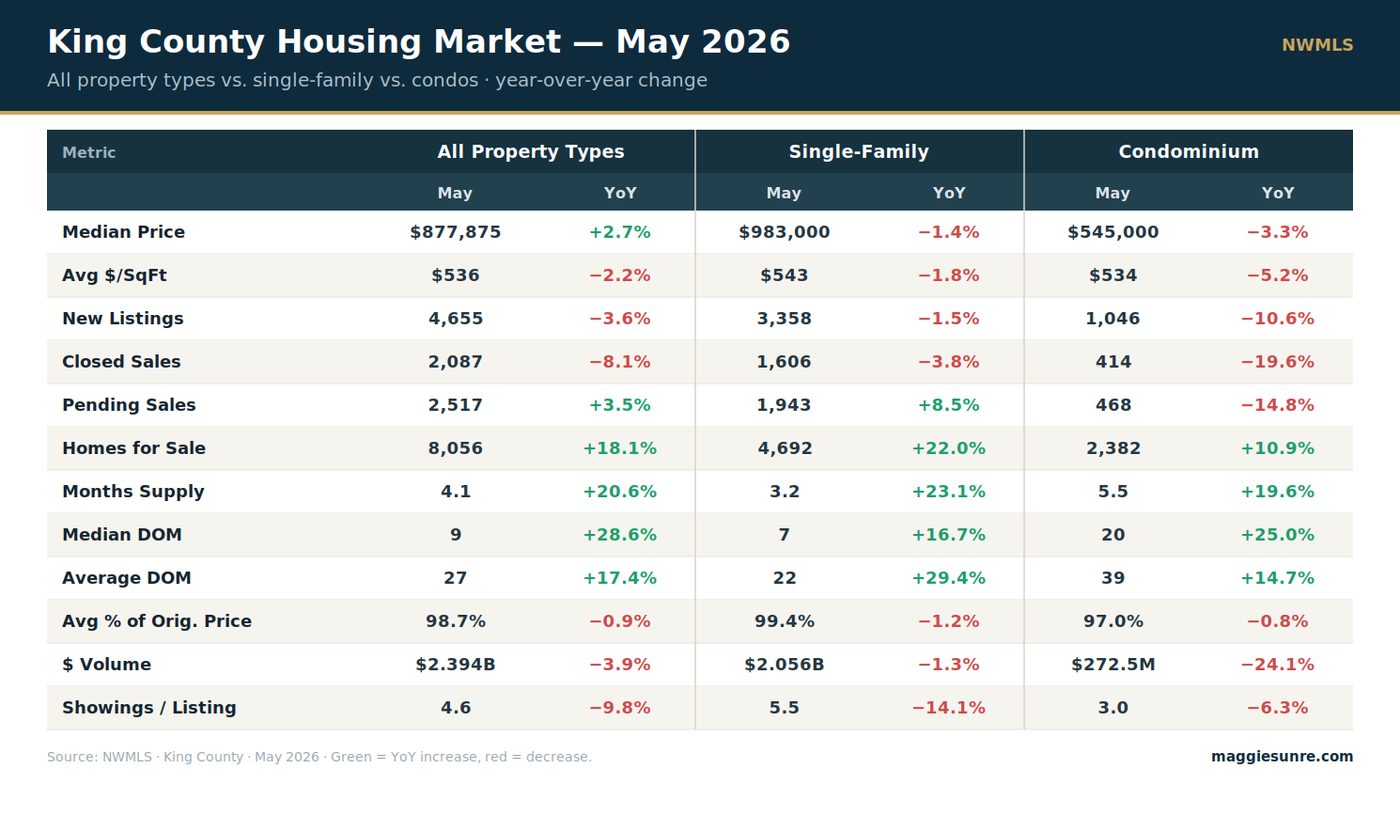
Spot the issue? Combined median rose 1.2%, but single-family dropped 1.4% and condos plunged 5.3%. The "increase" stems from more high-end sales skewing the median—a structural distortion, not universal appreciation.
Second, consider seasonality. May typically sees price jumps, yet the regional median held flat at $650K vs. April (Source: NWMLS, 2026). Stagnation during peak season is itself a cooling signal. Compare trends with the April 2026 market report.
What Inventory, Pace & Showings Reveal
Prices are rearview mirrors; inventory is the windshield. Watch these three official metrics (Source: NWMLS, 2026).
1. Rising listings: 21,381 active listings regionwide (+16.8% YoY, +15.2% MoM)—2026’s highest. King County inventory up 13.7%, Eastside surging 24.1%.
2. Shift toward balance: Months of supply reached 3.44, transitioning from seller’s to neutral market (4–6 months is true balance). Buyers gain leverage.
3. Seasonal upticks mislead: Closed sales +9.5% MoM, pending +7.7%, and lockbox visits +12.2%, but supply outpaces demand. For long-term baselines, see Seattle’s historical median prices.
Seattle’s Bifurcated Market: Single-Family Holds, Condos Struggle
Averages deceive. Single-family and condo markets now follow divergent paths.
By type: Single-family dipped just 1.4% vs. condos’ 5.3% drop (Source: NWMLS, 2026).
| Metric | Single-Family | Condo |
| King County Median | $975K | $540K |
| YoY Change | −1.4% | −5.3% |
By location: Counterintuitively, the high-end Eastside leads declines. Eastside single-family median at $1.5M (−7.6% YoY) underperforms countywide; its inventory surged 24.1%, with Bellevue west of I-405 listings up nearly 50% (Source: NWMLS, 2026). True resilience lies in mid-tier single-family homes; condos and Eastside luxury are softening. Condo buyers should review this Seattle condo guide first.
Will Seattle’s Housing Market Crash?
No, but expect gradual declines over 1–2 years. Beyond local cooling, two macro factors matter: U.S. economics and housing affordability.
Why the U.S. Economy Won’t Allow a Crash
America can’t afford a recession. With $39 trillion in debt exceeding annual GDP and $1 trillion in annual interest, the government will likely inflate away debt to prop up assets—a historical pattern. Conclusion: A full crash is improbable.
How High Prices & Rates Rebalance
Only three slow paths exist. Housing costs now consume 40%+ of income (vs. 30% healthy threshold), nearing 2006 pre-crash levels. Recovery requires:
| Path | Reality |
| Gradual price declines | Already occurring, slowly |
| Modest rate cuts | Likely, but 5–6% is the new normal (Source: Fortune, 2026) |
| Wage growth via inflation | Slow; prices rebound if rates drop |
Key clarification: Inflation props up nominal long-term prices, but short-term affordability requires real price declines. Thus, "no crash" and "near-term pain" coexist. This soft landing may take years—why homes remain long-term investments, not flips.
Why Long-Term Capital Still Bets on U.S. Housing
Patient money is entering—a sign of soft landing, not doom.
In late May, Berkshire Hathaway acquired Taylor Morrison for $8.5 billion, instantly becoming the nation's fourth-largest homebuilder (Source: ResiClub, 2026). Long-term capital doesn't enter at the brink of collapse—this confirms we're seeing a cooldown, not a crash.
Seattle Housing Market Outlook: Next 12 Months
Expect neither a surge nor a plunge—most likely modest declines followed by stabilization. Seasonal pressures and high inventory will prolong gradual declines through late 2026, with major swings unlikely next year.
Below is a summary of major institutional forecasts alongside my analysis.
| Metric | Projection | Rationale & Sources |
| National Prices | ≈ −0.1% | Zillow revised down from +0.5%, +0.1% (Source: Zillow, 2026) |
| National Prices | 2026 +0.8%, 2027 +1.5% | Moody's calls it "prolonged stagnation" (Source: Moody's, 2026) |
| 24-Institution Avg. | ≈ +1.43% | Zero predict sharp declines |
| Seattle (King County) | SFH −1.4%, Condos −5.3% YoY | NWMLS May actuals (Source: NWMLS, 2026) |
| Mortgage Rates | 6–6.5% range-bound | 5–6% is the new normal (Source: Fortune, 2026) |
| Seattle SFH | Slight dip / Resilient | Core areas remain supply-constrained |
| Seattle Condos | Continued weakness | High inventory, demand retreats first |
| My Take | Modest H2 declines; 2027 stabilization | Soft landing—no extreme moves |
Bottom line: This isn't pre-crash—it's a soft landing requiring 1–2 years of patience. For long-term fundamentals, see ourSeattle Housing Long-Term Outlook.
2026 Seattle: Buy or Sell? Actionable Advice
Wait if unstable; buy only with prerequisites if urgent. Sellers: Forget 2021 prices. Below are executable strategies.
Who Should Buy Now?
Two scenarios based on income stability and necessity:
1. Unstable income/work (e.g., industry layoffs): Wait. Preserving cash beats timing the bottom.
2. Stable job + urgent need (e.g., school districts, growing family): Proceed only if:
- You can hold 5+ years (short-term flips likely lose).
- Avoid softening segments—especially condos and homes with functional/location flaws.
- Don't wait for "the bottom"—prices rebound when rates drop.
Review theseCommon Seattle Homebuying Pitfallsbefore committing.
Seller Pricing Strategy
Price to recent comps—not 2021 peaks. Excess inventory means overpricing equals longer market time.
The golden window is narrowing. Act decisively: Good homes sell at realistic prices. Eastside luxury and condos face swelling inventory—adjust expectations faster. Reference thisBest Time to Sell in Seattleguide.
Seattle Price Recovery? May 2026 Update
Answer: No. Stock markets move fast; housing corrects slowly. May's minor "gains" reflect seasonal warmth—not recovery. Markets reward clarity and patience, not haste.
If you're considering buying/selling in Seattle or the Eastside, avoid gut decisions.Book a free consultationor start with afree home valuation. I'm Maggie—here to help you navigate Seattle real estate with data.
FAQ
Will Seattle mortgage rates drop in late 2026?
Possibly modest declines. Most predict 6%–6.5% range. 5%–6% is the new normal; 3% is history.
Down payment needed in Seattle?
Typically 5%–20% depending on loan type. Budget additional 2%–5% for closing costs and reserves.
Seattle's most resilient neighborhoods?
Mid-range SFH in core areas. Notably, Eastside luxury led May declines (−7.6% YoY). Condos/periphery weaken first.
Pricing strategy in a buyer's market?
Anchor to recent comps—not past highs. Excess inventory punishes aspirational pricing.
Rent vs. buy in Seattle?
Buy only if holding 5+ years. Transaction costs erase short-term gains. Break-even varies by down payment/rates.
Are 2026 new constructions worth it?
Case-by-case. Builder rate buydowns may help, but still require 5+ year holds.
Maggie Sun
Managing Broker | Buy, Sell & Invest in Seattle & Bellevue | Maggie Sun Real Estate Group
or another way