
The answer depends on the actual written offer, repair adjustment, closing timing and realistic open-market sale scenario. An instant price is not take-home proceeds; an asking price is not a guaranteed sale price.
Compare the same property under two realistic scenarios
Request the current Opendoor offer and every known deduction in writing. For a potential listing, ask for recent comparable closed sales, a suggested price range, a written marketing plan, negotiated broker compensation and estimated preparation costs. Do not assume a listing automatically sells above an iBuyer quote.
Confirm whether Opendoor currently serves the exact address and property type, and what conditions allow a price revision or cancellation. Do not treat an introductory online estimate as a final binding net offer.
| Question | Instant offer | Open-market listing |
|---|---|---|
| Price evidence | Written offer and revision conditions | Nearby comparable sales and live competition |
| Direct costs | Actual service charge, repair adjustment and closing costs | Negotiated compensation, prep, concessions and closing costs |
| Time and certainty | Written closing terms and conditions | Marketing time, buyer contingency and contract risk |
Use a net-sheet illustration, not a promise
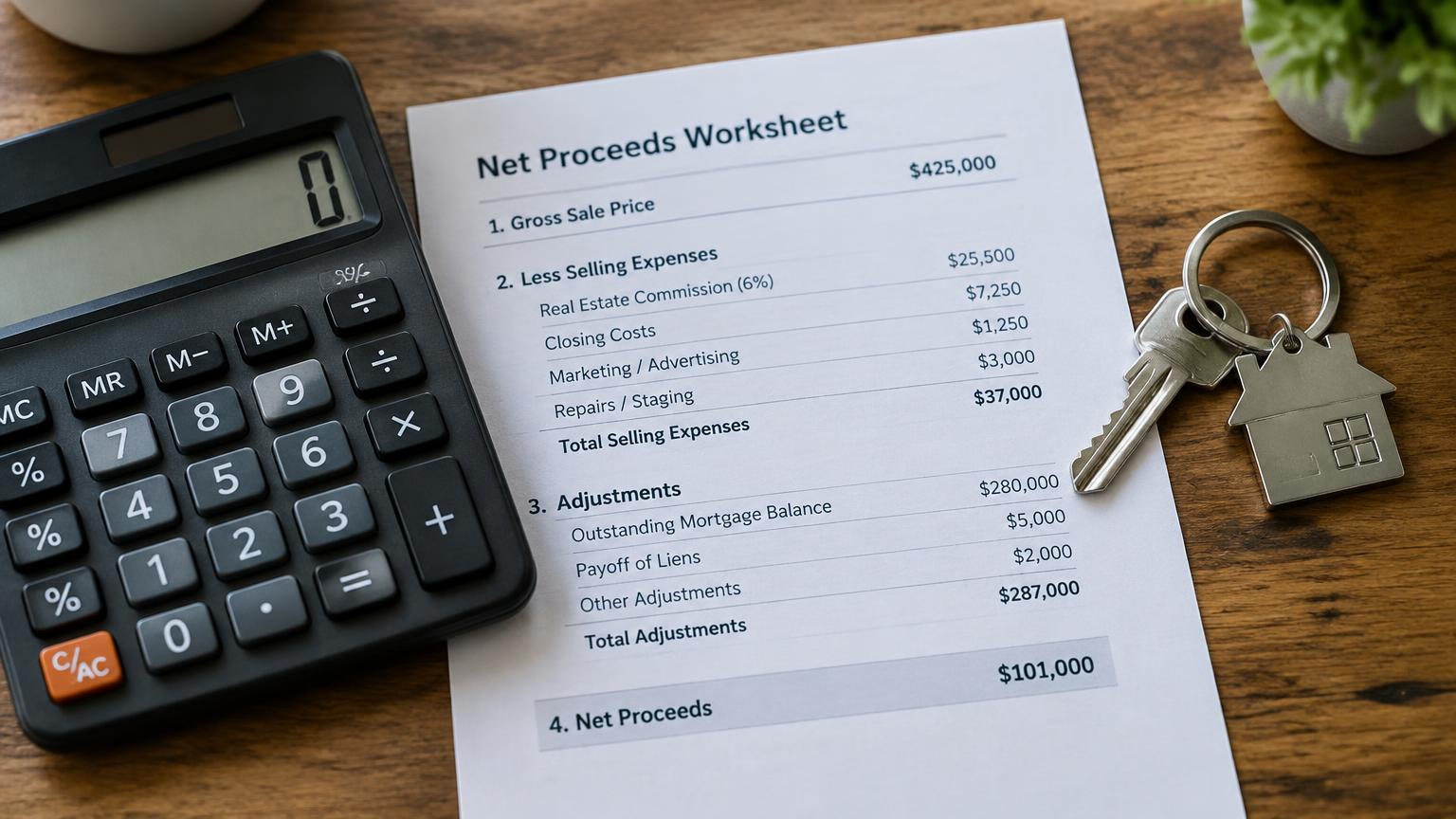
Hypothetical only: suppose a written instant offer is $1,000,000 with a $50,000 service charge, $20,000 repair adjustment and $10,000 other seller costs. Estimated pre-mortgage proceeds are $920,000. Suppose an open-market contract closes at $1,040,000 with $52,000 in negotiated brokerage compensation, $12,000 preparation and $12,000 in concessions and other seller costs. Estimated pre-mortgage proceeds are $964,000. In this illustration the difference is $44,000—not an average Opendoor discount.
Replace every input with current written figures and add the same categories to both sides: mortgage payoff, REET, escrow, title, concessions, taxes and holding costs as applicable. The model does not include tax advice or establish a local transaction statistic.
| Illustrative input | Instant offer | Listing |
|---|---|---|
| Closing price / offer | $1,000,000 | $1,040,000 |
| Service fee / negotiated brokerage cost | $50,000 | $52,000 |
| Repairs / preparation | $20,000 | $12,000 |
| Other seller costs / concessions | $10,000 | $12,000 |
| Pre-mortgage proceeds | $920,000 | $964,000 |
When speed may matter more than maximum price
An owner coordinating two homes or relocating on a deadline may value flexibility and a predictable closing window. Compare the total carrying cost of waiting: mortgage interest, taxes, insurance, utilities, maintenance and any overlap with the next home. The actual contract still matters; no option should be described as a guaranteed close.
Check what happens if the company revises its offer after inspection or withdraws. Compare that against the probability and timing of an open-market contract, not a theoretical top-of-range asking price.
- Request the final written net sheet from each path.
- Compare timing, inspection and cancellation conditions.
- Ask a CPA about tax issues for a rental or inherited property.
Avoid common comparison errors
NWMLS sales data does not establish Opendoor’s actual average net discount on your home, because off-market offers and seller-specific deductions require a comparable dataset. We do not claim an across-the-board 5–9% loss, a fixed 5% fee, or a guaranteed price premium from listing.
For a Bellevue property, make the decision with address-specific evidence and a written offer. Check Washington’s current REET rules separately from any service fee; tax brackets are not a flat city-wide percentage.
Frequently asked questions
Does Opendoor always charge five percent?
Do not assume a fixed current fee. Read the written offer and current seller terms for your address.
Is an instant offer guaranteed?
Review the contract for property review, price changes, closing conditions and cancellation rights.
Should I list instead?
Compare written net estimates, timing and risk. Neither option wins for every property.
Does NWMLS prove an average Opendoor discount?
Not by itself. NWMLS transactions and individual off-market offers are different data sets.
Can I negotiate the repair adjustment?
Ask the company directly and use independent contractor estimates where appropriate; the result is case-specific.
Make the two offers genuinely comparable
An instant-buyer quote and a traditional listing plan are different types of evidence. Compare a property-specific final written purchase agreement with a broker-supported range of likely closed prices, not with a hopeful asking price. On the listing side, include preparation, marketing, concessions, negotiated brokerage compensation, closing expenses and the extra carrying period. On the direct-sale side, include the actual service charge, repair adjustment, title allocation and conditions for revising or terminating the offer. Ask whether the offer applies in your ZIP code and to your property type before investing time in the comparison.
Washington real estate excise tax (REET) should be modeled for both paths when applicable, using current state and local rules. If one path closes sooner, show the benefit of avoided ownership expenses on a separate line, not as an assumed uplift to sale price. There is no evidence that either path always nets more for every home.
| Line item | Direct offer | Listed sale |
|---|---|---|
| Gross price | Final signed purchase price | Supported likely closing-price range |
| Transaction charges | Actual written service and closing terms | Negotiated compensation and seller costs |
| Condition costs | Written repair adjustment | Actual preparation bids and likely inspection response |
| Timing | Contracted and conditional closing date | Scenario for marketing and closing |
Value certainty without inventing a discount
A seller facing a job move, carrying two homes or a difficult showing schedule might prefer a shorter, simpler process even if the projected proceeds are lower. Conversely, a home with strong buyer demand or unusual features may warrant exposure to the market. Neither conclusion can be drawn from a generic service-fee percentage alone. Compare a best case, a base case and a slower-sale scenario using documented assumptions, and state what could cause each to change.
The FTC announced a 2022 settlement over past Opendoor marketing claims; that historical action does not establish that a particular current offer is unlawful or that every seller is underpaid. The appropriate response is to verify the actual agreement and calculate proceeds. If repairs, title or tenant issues are complex, obtain independent estimates and legal or tax advice before choosing.
Calculate the value of time on the same net sheet
To compare speed fairly, estimate the likely number of extra ownership months under each route. Use the property’s documented monthly interest, taxes, insurance, utilities, HOA and maintenance; keep principal payoff in the balance section so it is not incorrectly treated as a pure cost. Include required prep and cleaning for the listing path, but do not assume every house needs a renovation or that those costs can be recouped.
If the direct buyer’s timeline depends on inspections or title clearance, do not treat the proposed close date as guaranteed. For each path, write the assumptions beneath the net sheet and note which amounts are firm and which are estimates. The resulting difference is a decision range, not a promise of final proceeds.
Sources and further reading
Sources below support the linked general rules and lookup methods. Numerical tables in this article are explicitly labeled hypothetical illustrations, not market statistics or client outcomes. Confirm current forms, fees and transaction-specific advice with the appropriate professional before use.