
By Maggie Sun, Managing Broker · Last Updated: September 2026
If you're still evaluating whether this year is the right time to sell, consider reading "Is 2026 a Good Year to Sell Your Bellevue Home?" first. This article won't revisit timing decisions but focuses specifically on pricing strategies and net proceeds calculations. For foreign sellers' tax considerations, see our dedicated FIRPTA guide.
Data methodology: All market data reflects NWMLS closed sales unless otherwise noted, with property type specified as Single Family Homes. Each data point includes geographic scope and reporting period (either most recent monthly or three-month rolling data). Tax data sourced from King County Assessor, Washington State Department of Revenue (WA DOR), and IRS. School district information follows official district releases.
Table of Contents
- 1. Get Pricing Wrong, Everything Else Follows
- 2. How to Select Comparable Sales
- 3. Net Proceeds Worksheet
- 4. 30-Day Pre-Listing Checklist
- 5. Common Pitfalls & Seller-Specific Considerations
- 6. Case Studies: Two Typical Scenarios
- 7. Pricing Decision Flowchart
- FAQ
- Our Team's Current Market Analysis
- About the Author
- Data Sources
1. Get Pricing Wrong, Everything Else Follows
In markets where sale-to-list ratios fall below 100%, the initial listing price becomes the seller's most critical decision. Overpricing doesn't just mean "a few extra weeks on market" - it costs both time and eventual sale price. Properties lingering on MLS raise buyer suspicions, often requiring subsequent price reductions to go below what would have been the right initial price to regain attention.
Actual sale-to-list ratios vary by reporting period and property type. Request current figures from our team before pricing - we intentionally avoid publishing fixed percentages here.
We evaluate pricing accuracy through two key metrics in the first 14 days: showing traffic and buyer feedback patterns. Normal showings without offers indicate pricing or condition issues - not exposure. Low showing volume suggests problems with price range selection or marketing materials. These require fundamentally different corrections.
2. How to Select Comparable Sales
Bellevue's internal market variations far exceed outsiders' perceptions, though we won't prescribe neighborhood-specific comps here - those require case-by-case NWMLS verification. Our comp selection criteria demand: same neighborhood, same property type, similar build era, and closed within 90 days. Any deviation requires documented adjustments rather than direct application. Below shows typical additional considerations for broad area types (methodological reference only, not specific pricing advice):
| Area Type (Broad Categories) | Buyer Profile | Key Pricing Variables |
|---|---|---|
| West Bellevue Premium Areas | Move-up & Luxury Buyers | Lot, views, maintenance/renovation history outweigh pure square footage |
| Central Established Neighborhoods | Tech Family Buyers | Verified school assignments & commute times |
| East/South Value Areas | First-time & Budget-Conscious Buyers | Monthly carrying costs (tax+HOA+insurance) impact affordability more than total price |
| Downtown Bellevue Condos | Childless Households & Investors | HOA fees, reserves, special assessments |
These categories serve as methodological pointers - not neighborhood definitions nor substitutes for address-specific comps analysis. Precise pricing requires our team's current comps evaluation.
III. Net Proceeds Worksheet
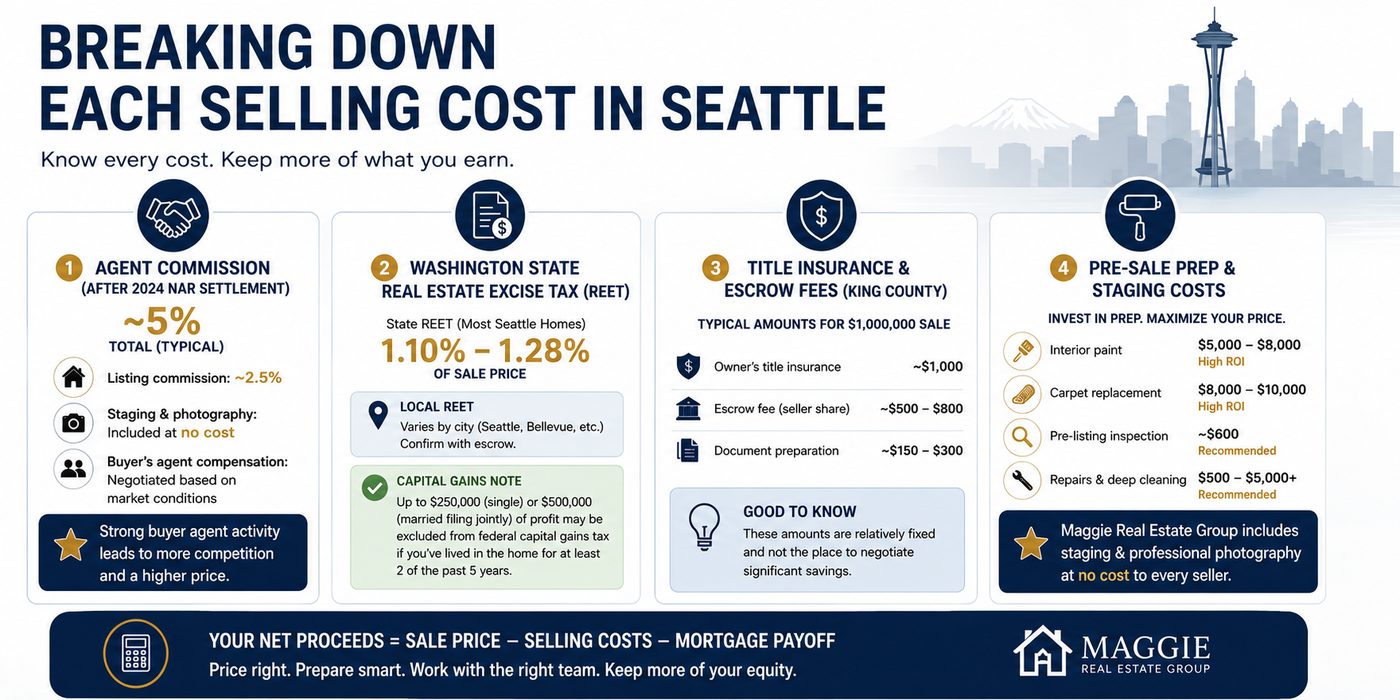
What sellers truly care about is their final take-home amount, not the sale price. Before listing, you should receive a net sheet detailing these items:
| Item | Basis | Notes |
|---|---|---|
| Sale price | Estimated range | Based on comps - provide a range, not a single point |
| Brokerage fees | As agreed | Separately negotiated between each party and their broker - no standard fixed percentage exists |
| REET (Real Estate Excise Tax) | State graduated tiers + local surcharges | Paid by seller, calculated progressively based on sale price tiers. Current tier thresholds, rates and local surcharges available on WA DOR official page |
| Closing & title fees | Escrow, title, recording | Relatively fixed amounts - can be quoted in advance |
| Pre-listing preparation | Cleaning, repairs, staging, photography | Controllable investments that directly impact first 14-day performance |
| Loan payoff & prorations | Remaining balance + property tax/HOA proration | Handled by escrow |
| FIRPTA withholding (foreign sellers only) | Withholding % based on sale price & property use | This is prepayment of federal income tax - reconciled when filing next year's return (refunded if overpaid). Whether qualification exists to reduce withholding via Form 8288-B requires case-by-case tax advisor review - no guarantee of reduction |
Illustrative example (demonstration only - not an actual transaction. Current rates/terms apply): For a hypothetical $1.5M single-family home sale with 5% total brokerage fees ($75K), estimated REET of $18K-$20K (including local surcharges - verify with official calculator), $5K closing costs, $8K preparation expenses, $600K remaining loan balance and $3K tax prorations, estimated net proceeds would be: $1.5M −$75K (fees) −$19K (REET midpoint) −$5K (closing) −$8K (prep) −$600K (loan) −$3K (prorations) ≈ $790K. All figures are hypothetical and don't represent actual transactions. Final net proceeds subject to escrow's official net sheet.
Clarifying a common misconception: FIRPTA isn't "an extra fixed tax for foreigners" but rather the buyer withholding a portion of sale proceeds remitted to IRS as prepayment of seller's federal income tax. Withholding percentage depends on sale price, buyer's intended use, etc. - see IRS FIRPTA guidelines. Whether reduction/waiver applies (including Form 8288-B eligibility) requires tax advisor review per case - we don't guarantee withholding reductions. Actual tax liability calculated based on capital gains when filing. Note: Washington's capital gains tax doesn't apply to real estate sales.
IV. 30-Day Pre-Listing Checklist
- Pull 90-day neighborhood comps to establish pricing range and minimum acceptable offer
- Conduct pre-inspection to address potential negotiation issues upfront
- Verify HOA documents, reserve reports and special assessments (critical for condos)
- Complete cleaning, repairs, staging and schedule professional photography/videography
- Obtain net sheet confirming acceptable proceeds after REET and all fees
- Foreign sellers: Consult tax advisor about FIRPTA requirements and Form 8288-B eligibility
V. Common Pitfalls & Seller-Specific Considerations
Most common mistake: Overpricing initially to "leave room for negotiation" - in sub-100% list-to-sale markets this prolongs DOM and reduces final price. Second pitfall: Confusing "low showings" (marketing/pricing issue) with "showings but no offers" (price/condition issue) - requiring different solutions. Move-up buyers should prioritize net sheet over sale price to ensure downpayment coverage; investors focus on holding period and depreciation impacts; foreign sellers often misunderstand FIRPTA as extra tax rather than prepayment - consult advisors about potential reductions.
From decision to sell to funds receipt, expect 8-12 weeks: 2-3 weeks pre-listing for comps, pre-inspection and staging; first 14 days on market reveal pricing accuracy; 3-5 weeks under contract for inspections, appraisal and closing. Condo sellers must additionally account for HOA document review and special assessments to prevent last-minute loan approval issues.
VI. Scenario Examples: Two Common Situations
The following two scenarios are hypothetical examples constructed for illustrative purposes (demonstration only), do not correspond to any specific real clients or transactions, and are solely intended to demonstrate common pricing and preparation logic.
Example 1: Relocation seller in a mature central neighborhood (hypothetical scenario). Suppose the seller initially tends to price based on comps from an earlier, hotter market phase that doesn't align with current conditions. The team uses comps from the last 90 days in the same neighborhood with matching home types and construction eras to establish a pricing range—a common corrective approach that effectively reduces risks of forced price reductions from prolonged listing periods.
Example 2: Downtown Bellevue condo seller (hypothetical scenario). Suppose the unit shows well but receives low showing traffic, with incomplete HOA financial disclosures being a common culprit—buyer's agents may question reserve fund adequacy, dampening showing interest. Completing HOA documents and proactively sharing reserve studies are standard remedies here, demonstrating that condo pricing and marketing should treat HOA materials as prerequisites rather than closing-stage formalities.
VII. Pricing Decision Framework
Breaking pricing decisions into a clear framework minimizes emotional choices: First, pull 90-day comps for matching neighborhood, home type, and construction era to establish a baseline range. Second, adjust this range up or down based on property condition and renovation history rather than defaulting to the median. Third, monitor showing traffic and feedback during the first 14 days post-listing to diagnose whether issues stem from price or presentation. Fourth, if adjusting, prioritize one decisive price change over multiple small reductions—the latter often signals desperation to buyers.
This framework applies universally but requires weighting adjustments: Relocation families must back-calculate pricing and marketing timelines from their new home's closing date. Investment owners need to factor holding periods and depreciation into net proceeds comparisons. International sellers should clarify FIRPTA and REET fund arrangements with escrow upfront to prevent last-minute liquidity gaps.
FAQs
Should I proactively reduce my listing price?
Don't preset reductions—focus on accurate initial pricing. In markets where sale-to-list ratios dip below 100%, correct first pricing outperforms reactive reductions. Current ratios should be verified against NWMLS data.
What taxes apply when foreign owners sell?
FIRPTA withholding rates depend on sale price and buyer usage—see IRS FIRPTA guidelines. This is an income tax prepayment, not an additional levy; actual tax liability calculates capital gains. REET follows WA DOR tiered rates plus local surcharges. Consult a tax advisor for case-specific advice.
Does remodeling pay off?
Project-dependent. Our data shows cleaning, minor repairs, staging, and professional photography deliver the most reliable returns; major renovations rarely recoup full costs in today's market.
What do first-time sellers most often overlook?
Net sheets. Many fixate on sale price without accounting for commissions, REET, closing costs, and prep expenses—leading to unpleasant surprises at closing. Obtain a net sheet estimate before pricing.
How does pricing differ for investment properties vs. primary residences?
Primary homeowners often overvalue emotional attachments and renovation costs, risking overpricing. Investors typically prioritize net proceeds and holding-period returns, making more rational decisions. We advise investors to also use recent 90-day comps rather than cost-based pricing.
Team Insights
Our 2026 observations: Bellevue buyers now scrutinize property conditions more intensely than in prior years. Within neighborhoods, homes with clean pre-inspection reports and updated mechanical/roof systems typically require fewer negotiation rounds and smaller concessions. We now treat pre-inspections as standard practice.
For condos, HOA financial health—not location—often dictates sale velocity. Buildings with underfunded reserves or pending special assessments face higher financing and psychological barriers—this must be priced in upfront. Explore our buyer, seller, and investment service pages, or contact us directly.
About the Author
Maggie Sun, Managing Broker|Practicing since 2022, Maggie leads our Bellevue-based bilingual team established in 2014. We serve Bellevue, Seattle, and Eastside clients in English and Chinese—from first-time buyers to relocation families and investors.
Last updated: September 2026. Market data sources appear below. This content provides general information only—not legal, tax, or investment advice. Consult licensed professionals for property-specific guidance.
Data Sources
- NWMLS — Bellevue single-family and condo sales (nwmls.com), 2026 Q2 rolling 90-day data
- WA DOR — REET tiered rates and local surcharges
- King County Assessor — kingcounty.gov/en/dept/assessor
- IRS — FIRPTA Withholding, Form 8288-B
- Team transaction experience — General pre-listing and negotiation observations (not statistical conclusions)
This content reflects general information from public data and team experience—not legal, tax, appraisal, or investment advice. Verify all details against your specific property and tax status.