

How Much You Need to Live Comfortably in Kirkland WA 2026
Kirkland is expensive, but not in a simple way. The real question is not only rent or home price. It is whether your monthly budget fits the lifestyle you want. For many buyers, Kirkland means lake access, Eastside convenience, strong resale demand, and a shorter daily radius. Those benefits are valuable, but they are not cheap.
How Much Does It Cost to Live in Kirkland, WA?
A comfortable lifestyle in Kirkland usually needs about $6,000-$8,000 per month for a single renter. Families often need $13,000-$17,000 per month because housing, childcare, transportation, and daily life add up quickly.
PayScale’s Kirkland cost-of-living calculator shows Kirkland is 49% higher than the national average. It also shows housing is 113% higher than the national average: PayScale, 2026.
LivingCost’s Kirkland page was updated on June 21, 2026. It estimates the baseline monthly cost at $3,012 for one person with rent. It estimates $6,847 for a family of four with rent: LivingCost, 2026.
| Household Type | Baseline Monthly Cost | Comfortable Monthly Budget |
| Single person | ~$3,012/mo with rent | $6,000-$8,000+/mo |
| Couple renting | — | $9,000-$12,000+/mo |
| Family of four | ~$6,847/mo with rent | $13,000-$17,000+/mo |
| Homeowner | — | $12,000-$20,000+/mo |
These numbers are not a rule for every household. They are a planning range. A renter mostly watches rent, utilities, transportation, and lifestyle habits. A homeowner also needs to plan for mortgage, tax escrow, insurance, HOA if any, upkeep, and interest rate.
Apartments.com’s July 2026 Kirkland rent data lists average rent at $2,335 per month. It also shows three-bedroom house rent around $4,977 per month: Apartments.com, July 2026.
That is why “Can I afford Kirkland?” is not one number. It depends on your household structure, location, and property type.
If you are still comparing Eastside cities, start with the Kirkland city and neighborhood guide. It helps you understand where the money goes.
Kirkland Cost of Living Breakdown
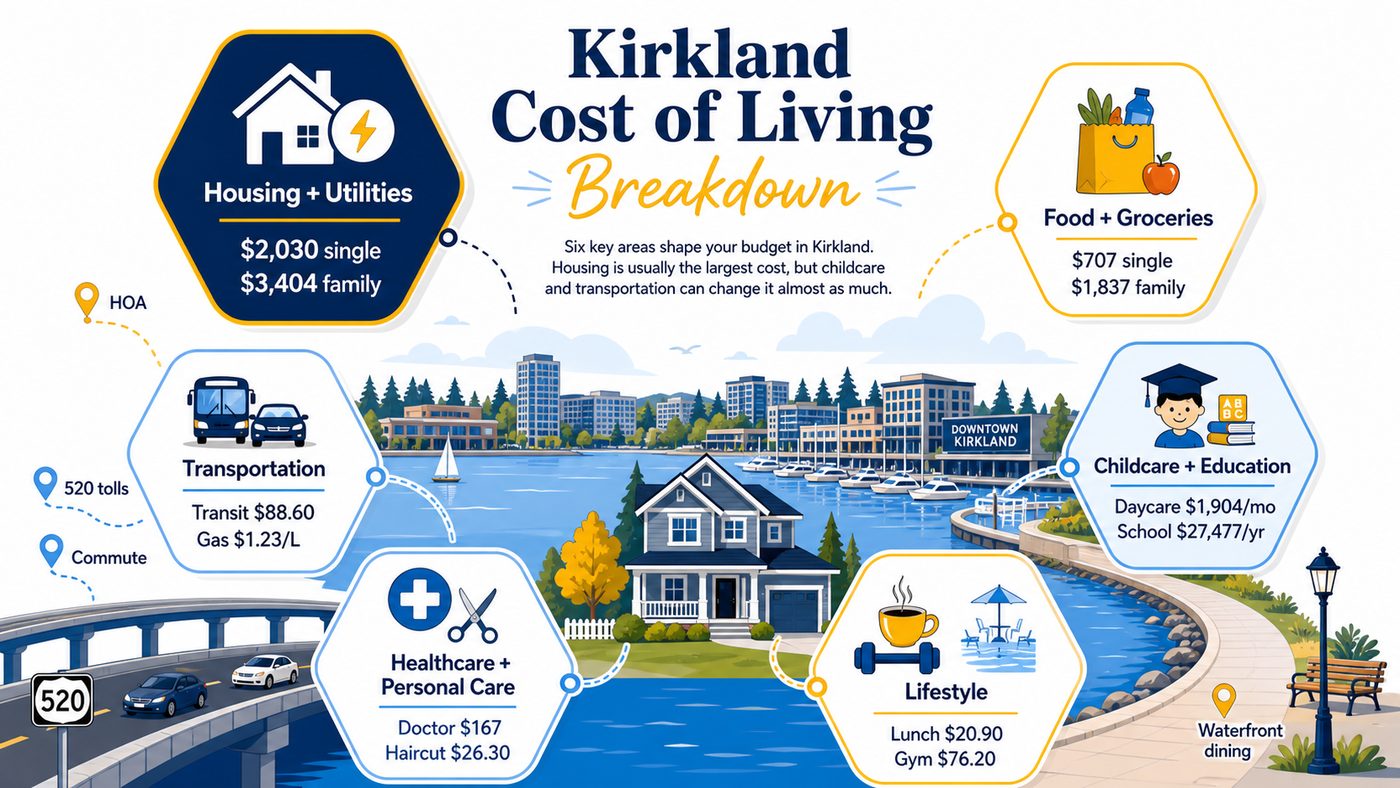
Kirkland’s real cost comes from six areas: housing, food, transportation, childcare, healthcare, and lifestyle spending. For most households, housing is the largest cost, but childcare and transportation can change the budget just as much.
| Cost Category | 2026 Reference Point | What To Watch In Kirkland |
| Housing and Utilities | Rent and utilities: $2,030 one person; $3,404 family of four | 98033, Downtown, lake areas, HOA, property tax |
| Food and Groceries | Food: $707 one person; $1,837 family of four | Costco habits, premium groceries, family size |
| Transportation and Car Costs | Transit pass $88.60; gas $1.23/L | Car ownership, insurance, 520 tolls, commute route |
| Childcare and Education | Daycare $1,904/mo; international school $27,477/year | Mortgage plus childcare can strain budgets |
| Healthcare and Personal Care | Doctor visit $167; haircut $26.30 | Convenient care, but Eastside services cost more |
| Lifestyle Spending | Lunch $20.90; dinner for two $81.40; gym $76.20 | Waterfront dining, coffee, fitness, kids activities |
Housing and Utilities
Housing is the biggest reason Kirkland feels expensive. In Kirkland, buyers often pay for location, land, access, and future flexibility.
That matters most in places like 98033, Downtown Kirkland, Moss Bay, lake-adjacent areas, West of Market, and Houghton. Many older Kirkland homes still sell for high prices. That can surprise first-time Eastside buyers.
The reason is simple. Builders and investors care about land. Kirkland has many cottage-style and older homes. Some buyers live in them as-is. Others remodel, expand, or rebuild later. So part of the price is future land value. That is very different from buying only finishes.
LivingCost lists a Kirkland one-bedroom city-center apartment at $2,095. It lists a three-bedroom city-center apartment at $3,691.
Zillow’s Kirkland housing data shows a typical home value of $1,227,283. That data runs through June 30, 2026: Zillow, June 30, 2026.
Redfin’s Kirkland market page shows a median sale price of $1,279,234 in May 2026. That covers all home types: Redfin, May 2026.
Many clients first look at townhomes. They see a lower price than single-family homes. Then they notice the HOA. That payment stays every month. So the better question is not “What is the price?” It is “What is my true monthly cost?”
If you are early in the process, review the Seattle home buying FAQ. The same monthly-cost thinking applies across the Eastside.
Food and Groceries

Food costs in Kirkland depend heavily on household size and habits. The city is not cheap, but daily errands can be very efficient.
For food, LivingCost estimates $707 per month for one person. It estimates $1,837 for a family of four.
Those numbers can move fast. A family that cooks often may stay controlled. A family that mixes groceries, takeout, and weekend dining may spend more. That is common in Kirkland.
Local grocery options include Costco, Whole Foods, Metropolitan Market, Safeway, Trader Joe’s nearby, Asian grocery options nearby, and Downtown Kirkland restaurants. Many clients describe Kirkland as “easy.” They can shop, eat, pick up kids, and get home quickly.
That matters after work. Fifteen saved minutes can feel like real money. The buyer angle is important here. A cheaper home farther out may not feel cheaper every day. You may spend more time driving. You may also lose the short daily radius.
For many families, Kirkland’s grocery and dining costs are not only expenses. They are part of buying a smoother week.
Transportation and Car Costs
Transportation in Kirkland depends more on your exact neighborhood than the city name. Many households still need a car, even with decent Eastside access.
For transportation, LivingCost lists a local monthly transit pass at $88.60. It lists gas at $1.23 per liter.
Those numbers are useful, but they do not show full Kirkland reality. Most households also need to consider car payments, insurance, gas, maintenance, parking, SR-520 tolls, bridge traffic, I-405 timing, and school drop-off routes.
This is where local experience matters. Kirkland is not one commute pattern. A 98033 home near Downtown Kirkland may feel very different. It can offer easier access to I-405, Bellevue, and Seattle routes.
North Kirkland may feel more affordable. But the route may add time. That is why we tell buyers not to shop by city name only. Shop by actual morning route.
Ask yourself: Do I work in Bellevue? Do I work near Microsoft in Redmond? Do I cross SR-520 often? Do I need Seattle access? Do I need school drop-off first? Will we keep one car or two?
For a deeper Eastside location comparison, see the best Eastside Seattle neighborhoods guide. It helps frame commute and lifestyle together.
Childcare and Education

Childcare can be the cost that changes a Kirkland budget the fastest. Many families feel comfortable on paper, then feel tight after daycare starts.
For families, LivingCost lists daycare or preschool at $1,904 per month. It lists international primary school at $27,477 per year.
That is why many tech families feel pressure. They may have strong incomes and still feel stretched. The reason is often simple: mortgage, childcare, car costs, groceries, activities, and savings all happen at the same time.
Many families consider Kirkland because of Lake Washington School District, stable neighborhoods, parks, waterfront access, Eastside job access, community feel, and strong resale demand.
But education is not free in practice. Even public-school families may pay for preschool, after-school care, summer camps, sports, music lessons, tutoring, and weekend activities.
This is why family buyers should run two budgets. One is “before kids’ programs.” The other is “real school-year life.” That second number is usually more honest.
Healthcare and Personal Care
Healthcare is not usually the largest monthly cost in Kirkland. Still, personal care and household services can make the real budget higher.
For healthcare and personal care, LivingCost lists a doctor visit at $167. It lists a simple haircut at $26.30 and cold medicine at $9.47.
Kirkland has strong healthcare access. EvergreenHealth is nearby. Eastside medical, dental, therapy, and specialty care are also convenient. That convenience is valuable, especially for families and older homeowners.
But personal services can cost more on the Eastside. That includes haircuts, dental visits, fitness, cleaning services, yard care, handyman work, home maintenance, and pet care.
This category is easy to miss. People usually budget rent first. Then real life arrives. The small recurring services start adding up. A Kirkland budget should leave room for them. Otherwise, the city can feel tighter than expected.
Lifestyle Spending

Lifestyle spending is part of Kirkland’s real cost. A comfortable budget should include the way residents actually use the city.
For lifestyle spending, LivingCost lists lunch at $20.90. It lists dinner for two at $81.40 and cappuccino at $5.34. It also lists gym membership at $76.20 and a cinema ticket at $16.60.
That matches how many residents actually live. They walk by Lake Washington. They meet friends downtown. They get coffee after school drop-off. They go out on weekends.
This is not “things to do” content. It is a monthly budget issue. A bare-minimum Kirkland budget may cover rent and food. A comfortable Kirkland budget covers daily enjoyment.
Many clients choose Kirkland because of one feeling. They want home life to be easier. They want kids to feel safe. They want errands to be close. They want dinner options nearby. They want a place with community.
That is the real cost of Kirkland. It is not just housing. It is the cost of a smoother lifestyle.
Is Kirkland More Expensive Than Bellevue or Seattle?
Kirkland is often close to Bellevue and Seattle in monthly cost. The difference is where the money goes: Bellevue feels more urban, Seattle varies by neighborhood, and Kirkland charges for lifestyle and land.
LivingCost’s nearby-city data puts Kirkland at $3,012 for one person. It puts Bellevue at $3,164 and Seattle at $3,183.
That does not mean Kirkland is always cheaper. Housing type matters more than city averages.
| City | Cost Feel | Buyer Takeaway |
| Kirkland | Lifestyle premium | Great for lake access and Eastside convenience |
| Bellevue | Luxury and job-center premium | Strong for offices, shopping, and high-end condos |
| Seattle | Urban cost mix | More neighborhood variety and commute tradeoffs |
| Redmond | Tech commute premium | Strong for Microsoft-area buyers |
Kirkland can be a better fit if you want quieter Eastside living. It can be costly if you want Downtown or lake-adjacent homes.
Bellevue may fit buyers who want a denser urban core. You can compare that against our Bellevue cost of living guide.
Seattle may offer more varied price points. But commute and lifestyle can change the value. The best comparison is not city versus city. It is your monthly life in each location.
Ask: Where do I work? How often do I cross the lake? Do I need walkability? Do I want a larger lot? Do I need daycare nearby? How much home maintenance can I handle?
How to Lower Your Cost of Living in Kirkland
The best way to lower Kirkland’s cost is to choose the right area and property type. A cheaper list price does not always mean a cheaper monthly life.
| Strategy | Why It Helps |
| Compare Juanita, Totem Lake, and North Kirkland | These areas may offer more budget flexibility |
| Watch HOA dues | A lower price can still carry a high monthly cost |
| Estimate property tax early | Tax escrow affects monthly payment |
| Do not max out pre-approval | Lender approval is not a lifestyle budget |
| Compare commute routes | Time and tolls can change real cost |
| Budget maintenance | Older Kirkland homes need reserves |
| Check utility patterns | Larger homes can cost more to run |
| Think about childcare timing | Daycare plus mortgage can feel heavy |
Apartments.com’s July 2026 rent data lists North Juanita average rent at $1,974 per month. It presents North Juanita as one of the more budget-friendly Kirkland rental areas.
That does not mean those areas are “cheap.” It means they may offer more breathing room.
For buyers, property condition matters. A lower purchase price can hide repair costs. Older homes may need roof work, sewer scope review, drainage work, window updates, heating upgrades, electrical updates, or remodeling budget.
A newer townhome may reduce maintenance, but HOA dues can offset that. A condo may lower entry price, but reserves and assessments matter.
If you want a broader housing search frame, read our Seattle home buying guide. The same due diligence applies in Kirkland.
Conclusion: Can You Afford Kirkland Comfortably?
Kirkland can be worth the cost, but only if the numbers fit your life. Do not judge it by rent or list price alone. Look at housing, childcare, commute, lifestyle, savings, and future flexibility together. If you are considering moving to Kirkland, Maggie Sun Real Estate Group can help you compare homes by true monthly cost, not just list price.
FAQ
Is Kirkland, WA more expensive than the national average?
Yes, Kirkland is more expensive than the national average. PayScale shows Kirkland is 49% higher overall. The biggest driver is housing.
How much money do you need to live comfortably in Kirkland?
Yes, many single renters should plan for at least $6,000-$8,000 per month. Families often need $13,000-$17,000 per month. The exact number depends on rent, childcare, cars, and savings.
Is $6,000 a month enough to live in Kirkland?
Yes, $6,000 per month can work for some single renters. It may feel tight with a newer apartment, car payment, debt, or heavy dining habits. It is usually not enough for a family.
Is Kirkland cheaper than Bellevue?
No, Kirkland is not always clearly cheaper than Bellevue. LivingCost shows Kirkland slightly lower for one person. But home type, location, and commute can change the answer.
Is buying in Kirkland more expensive than renting?
Yes, buying in Kirkland is usually more expensive monthly than renting. The reason is the high home price, property tax, insurance, HOA if any, and maintenance. Buying may still make sense for long-term owners.
Which Kirkland areas are more budget-friendly?
Yes, some Kirkland areas can be more budget-friendly than Downtown or lake-adjacent neighborhoods. Buyers and renters often compare Juanita, Totem Lake, North Kirkland, Finn Hill, and Kingsgate. Always compare commute and property condition too.
Maggie Sun
Managing Broker | Buy, Sell & Invest Seattle & Bellevue | Maggie Sun Real Estate Group
or another way