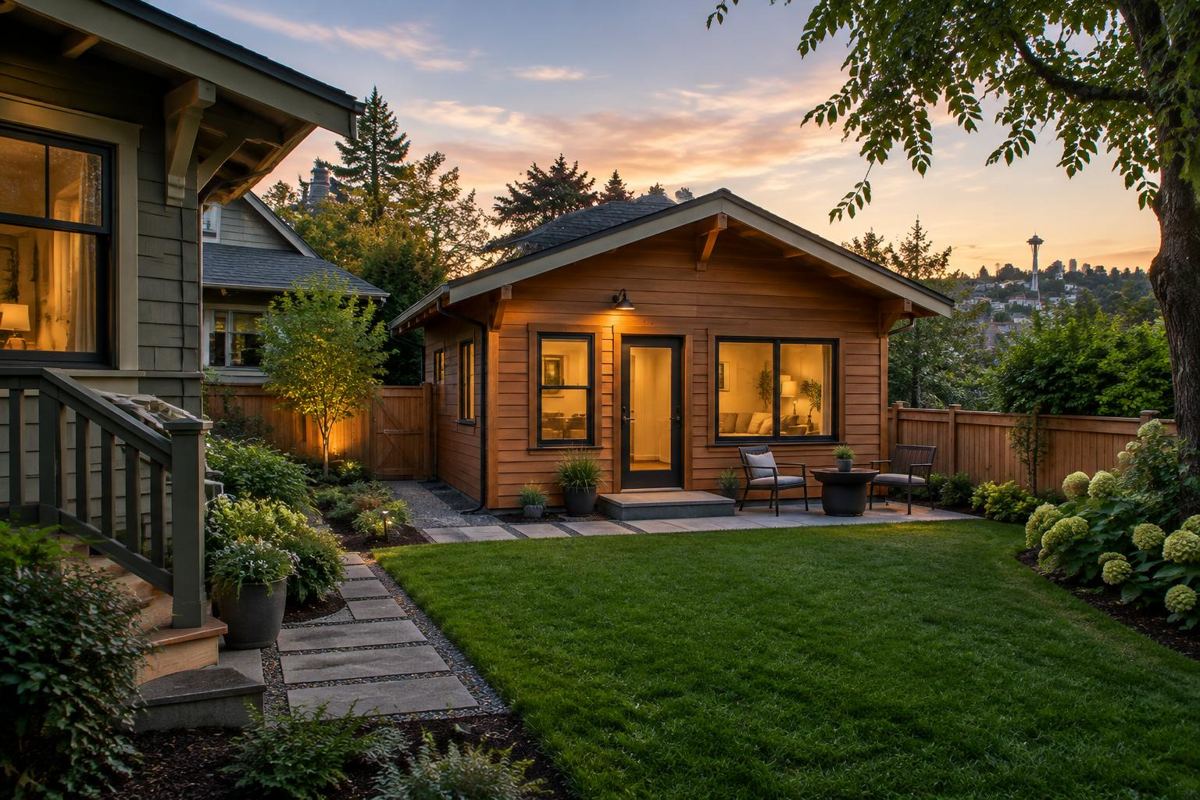
Short answer: Compare cash, a HELOC, a home equity loan, a cash-out refinance, a qualifying renovation mortgage and a construction loan. Equity-based borrowing uses current value; some renovation and construction products use completed value. Availability, ADU count, unit classification, rental-income treatment and draw requirements must be checked for the exact product.
Some ADU funding options rely on equity you already have; others may use an approved as-completed value. Neither category guarantees faster approval or a larger loan. The six routes below are a starting point for collecting comparable lender quotes, not a complete list of every product.
The rules lenders check first
RCW 36.70A.681 sets ADU requirements for covered jurisdictions and lots within urban growth areas, including limitations on owner-occupancy restrictions. Seattle’s SDCI ADU page says that only two units on a property may be ADUs and that ADUs must comply with zoning, density, building and other applicable codes. Local permission does not establish loan eligibility. Have a designer confirm your parcel’s proposed units and permit path.
Check the current Fannie Mae ADU eligibility page and the lender’s applicable Selling Guide. That page states that properties with multiple ADUs are ineligible under the described financing policy. Its HomeStyle Renovation FAQ discusses adding a qualifying ADU, not unrestricted financing for every locally permitted configuration. Obtain written confirmation of the applicable product, property classification and current rules before applying.
ADU financing options side by side
| Option | Lends against | Main advantage | Main drawback |
|---|---|---|---|
| Cash or savings | — | No interest, no lender approvals | Ties up liquidity; reduces emergency reserves |
| HELOC | Current equity | Draw only what you need; keeps first mortgage | Usually variable rate |
| Home equity loan | Current equity | Fixed rate and payment; keeps first mortgage | Lump sum; interest starts on the full amount |
| Cash-out refinance | Current equity | One loan, one payment | Replaces your existing rate on the whole balance |
| Qualifying renovation mortgage; verify the individual program, ADU configuration and lender rules | As-completed value | Can lend more when current equity is limited | Plans, contractor approval, inspections and draw rules |
| Construction loan | As-completed value | Designed for larger builds | Short term, draw inspections, higher complexity |
For HomeStyle, use the Fannie Mae renovation FAQ and the applicable ADU property policy. Do not transfer one product’s rules to Freddie Mac, FHA or a lender’s construction loan. Ask each lender to cite its current guide section covering your new-build or renovation scope, number of units, ADU count and any rent used to qualify. A general product page is not an approval for a particular project.
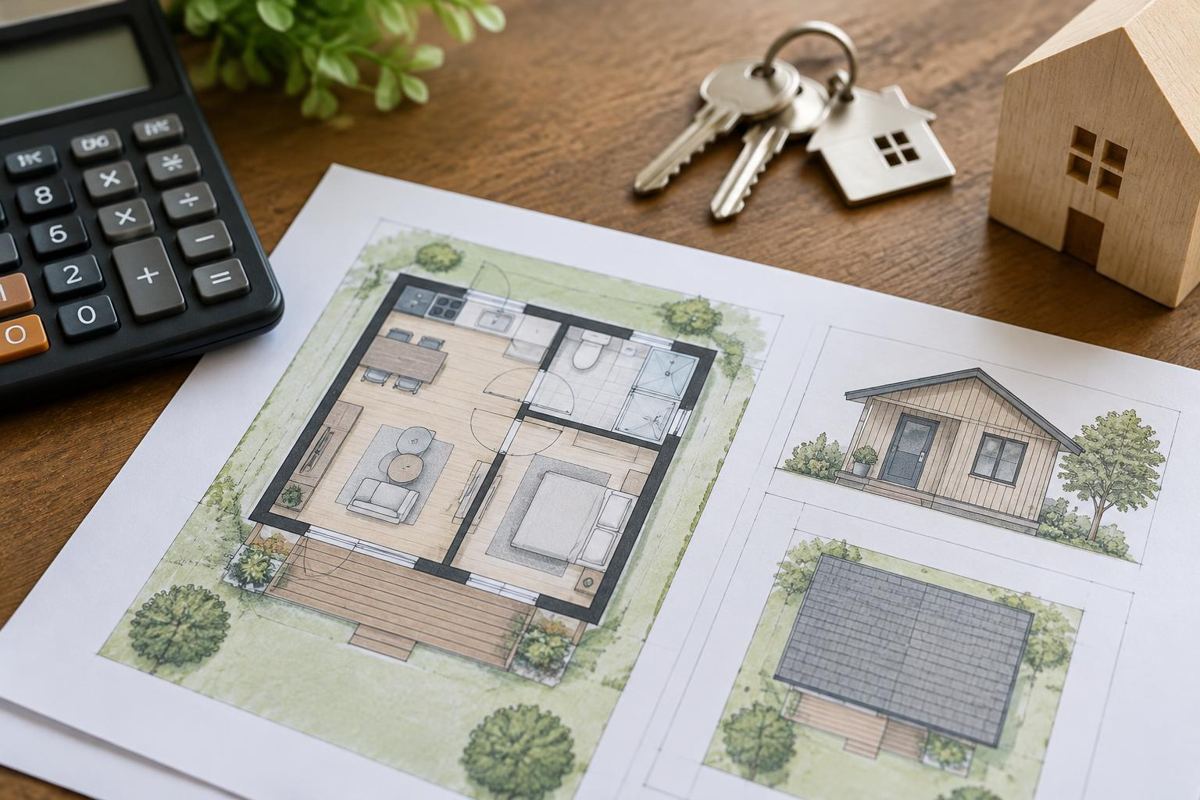
How to choose: four questions
1. What is your current mortgage rate?
Use current written lender quotes rather than a national purchase-mortgage average to compare a HELOC, a second lien and a cash-out refinance. If your first mortgage has a low fixed rate, replacing the entire balance can create a different cost from borrowing only the extra amount. Compare rates, fees, loan term, total payments and the expected holding period.
2. Does your current equity cover the build?
Equity-based loans are limited by the lender's maximum combined loan-to-value on today's appraised value. If that does not cover the builder's estimate plus a contingency, consider loans based on the as-completed value.
3. Will ADU rent help you qualify?
Some agency programs allow limited rental income from an ADU on a one-unit property to be considered under specific conditions. Rules differ by program and change over time, so ask each lender how it treats ADU income in writing rather than assuming it will count.
4. How predictable do you need the payment to be?
A variable-rate HELOC is flexible but can rise. A fixed home equity loan or fixed-rate refinance trades flexibility for certainty. Run a test at a higher rate before committing.
Step by step: financing an ADU
- Confirm feasibility with your city's ADU rules and a designer.
- Get a preliminary design and a written builder estimate with a contingency.
- Check your equity: current balance, estimated value and lender combined-LTV limits.
- Request written quotes for at least two option types from at least two lenders.
- Compare total interest and fees over the build and the first few years.
- Finalize plans and permits; align the loan draw schedule with the builder's payment schedule.
- Update insurance before construction and again before occupancy.
Costs beyond the loan
Budget for design, permits, utility connections, insurance and construction reserves. New construction may change assessed value; that does not establish a fixed percentage increase in the tax bill. RCW 36.70A.681 limits covered ADU impact fees to no more than 50% of those imposed on the principal unit, not every permit, sewer or utility charge. Personal-use home-debt deduction conditions are in IRS Publication 936; rented or mixed-use ADU expenses require appropriate allocation under Publication 527.
A note on returns
For a leveraged rental project, define cash-on-cash return consistently. Annual pre-tax cash flow after the selected reserve = collected annual rent after vacancy and credit loss − annual operating expenses − annual capital reserve − annual principal-and-interest debt service. Operating expenses include property tax, insurance, HOA where applicable, routine maintenance and management. Separate tax and insurance escrow out of loan payments to avoid deducting them twice.
Total cash invested is the owner’s cash contribution to construction, design, fees, loan closing, initial reserves and other initial costs—not the amount borrowed. Cash-on-cash return = annual pre-tax cash flow after the chosen reserve ÷ total cash invested × 100%. This differs from NOI divided by property value and excludes appreciation and tax effects.
| Hypothetical example, not a rent or cost estimate | Annual amount |
|---|---|
| Scheduled rent assumed at $2,500/month | $30,000 |
| Assumed vacancy and credit loss at 5% | −$1,500 |
| Assumed operating expenses | −$8,000 |
| Assumed capital reserve | −$2,000 |
| Assumed principal-and-interest debt service | −$15,000 |
| Annual pre-tax cash flow after reserve | $3,500 |
| Assumed owner cash invested | $100,000 |
| Illustrative cash-on-cash return | 3.5% |
All inputs are assumptions for illustrating the method, not a local return claim. Replace them with comparable rent evidence, project bids and actual loan terms. At a hypothetical 10% vacancy/credit loss with the same other inputs, annual cash flow falls to $2,000 and the return to 2.0%. Test rate changes, delayed occupancy and overruns as well.
Questions to ask every lender
Lender quotes are only comparable when you ask the same questions. For each option you are considering, request written answers to:
- What is the maximum combined loan-to-value, and is it based on today's value or the completed value?
- What is the rate, and is it fixed or variable? For variable rates, what is the index, margin and any cap?
- What are the closing costs, appraisal fees, annual fees and any prepayment penalty?
- How are funds released: lump sum, draws on request, or inspection-based draws to the contractor?
- Do you require licensed contractors, approved plans or permits before closing or before each draw?
- How do you treat projected ADU rental income, if at all?
- How long does approval and closing usually take for this product?
Lay the answers side by side with your builder's payment schedule. The best option is the one whose cost, timing and conditions fit your project, not simply the lowest advertised rate.
Frequently Asked Questions
What is the cheapest way to finance an ADU?
Cash avoids interest but reduces your reserves. Among loans, the lowest total cost depends on your current mortgage rate, how much you need and how long you will carry the balance. Compare written quotes.
Can I finance an ADU with an FHA loan?
Do not assume eligibility from a generic FHA or 203(k) page. Ask an FHA-approved lender for the current guide section that covers your proposed unit configuration and construction scope, any rental-income use and the applicable draw rules. Obtain written project-specific confirmation.
How do I finance an ADU with little equity?
Look at loans based on the as-completed value, such as renovation mortgages or construction loans, which require plans, bids and inspections.
Do Seattle ADU rules allow two ADUs on one lot?
Seattle SDCI states that only two units on a property may be ADUs, subject to applicable zoning, density and other codes. That local permission does not establish lender eligibility; check the actual parcel plan and each financing program separately.
Sources and Further Reading
The official sources below explain the legal, tax, permitting and financing points discussed here. Rules apply to specific transactions and can change. Confirm the applicable requirements before acting. The numeric examples are illustrative unless a dated source is stated.
- RCW 36.70A.681 – Accessory dwelling units
- Seattle SDCI – Accessory dwelling units
- Fannie Mae – HomeStyle Renovation mortgage
- IRS Publication 936
- Fannie Mae — ADU property eligibility (confirm applicable current Selling Guide with lender)
- Fannie Mae — HomeStyle Renovation FAQ
- IRS Publication 527 — Residential Rental Property
Want to know how an ADU fits your property plans?
Discuss your property and goals with the team. Contact Maggie Real Estate Group. Confirm the scope of any brokerage service before proceeding; lending, engineering and tax decisions belong with the relevant qualified professionals.
Related Guides
- Topic hub: ADU financing in Seattle and the Eastside
- Buying a home with Maggie Real Estate Group
- Financing an ADU in Seattle: When a HELOC Works for a Backyard DADU
About the Author
Maggie Sun, Managing Broker, leads Maggie Real Estate Group, serving buyers and sellers in Seattle and the Eastside in English and Mandarin. This guide is general information, not legal, tax or lending advice; consult a Washington real estate attorney, CPA or licensed loan officer for your situation.
Last updated: November 2026.