Short answer: If you already have a low fixed-rate mortgage and enough equity, a home equity line of credit (HELOC) lets you borrow only what the DADU build needs, as you need it, without replacing your first mortgage. It carries a variable rate and your home secures it, so compare it with a cash-out refinance and renovation loans using your own numbers before you start design.
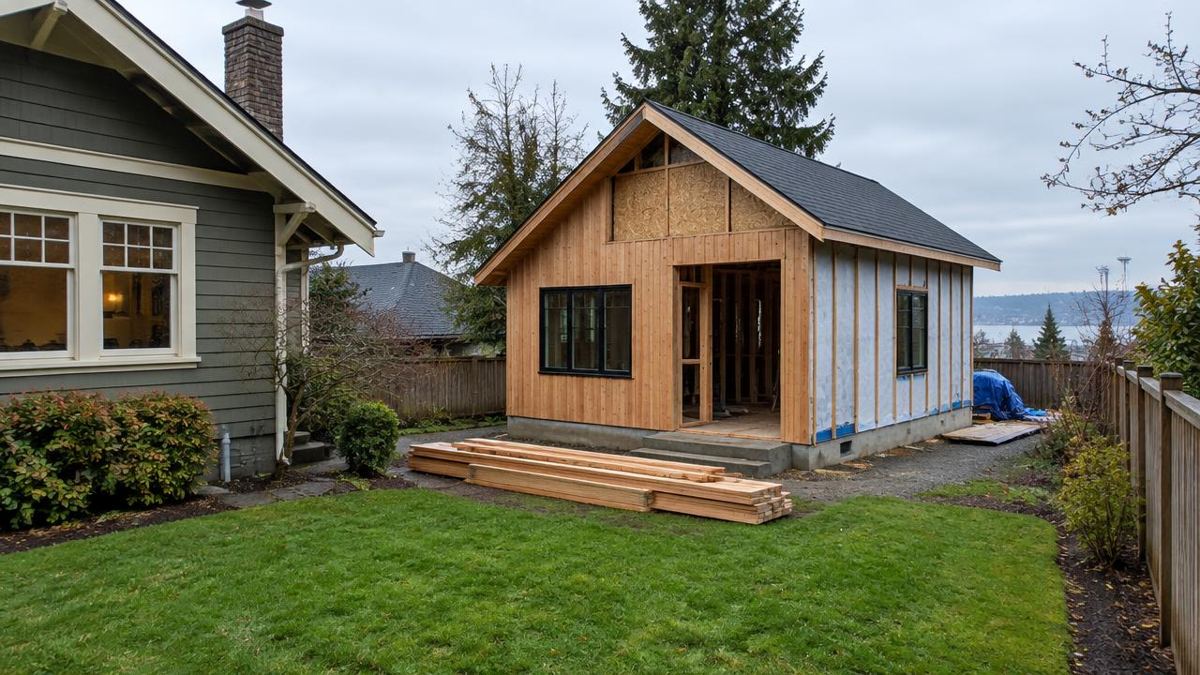
A detached accessory dwelling unit (DADU), often called a backyard cottage in Seattle, is one of the most common ways homeowners add space for family or rental income. The financing question usually comes down to one choice: borrow against the equity you already have, or replace your mortgage with a bigger one. This guide focuses on that choice for Seattle owners, and on the permit and timing points that affect how much you borrow and when.
Can I build a DADU on my Seattle lot?
RCW 36.70A.681 sets ADU requirements for covered jurisdictions and lots within urban growth areas, including limitations on owner-occupancy restrictions. Seattle’s SDCI ADU page says that only two units on a property may be ADUs and that ADUs must comply with zoning, density, building and other applicable codes. Local permission does not establish loan eligibility. Have a designer confirm your parcel’s proposed units and permit path.
Check the current Fannie Mae ADU eligibility page and the lender’s applicable Selling Guide. That page states that properties with multiple ADUs are ineligible under the described financing policy. Its HomeStyle Renovation FAQ discusses adding a qualifying ADU, not unrestricted financing for every locally permitted configuration. Obtain written confirmation of the applicable product, property classification and current rules before applying.
HELOC vs cash-out refinance for a DADU
Both options use your home's equity. The difference is what happens to your existing first mortgage.
| HELOC | Cash-out refinance | |
|---|---|---|
| Your first mortgage | Stays in place at its current rate | Replaced by a new, larger loan at today's rate |
| How you receive funds | Credit line; draw as invoices come in | Lump sum at closing |
| Rate | Usually variable | Fixed or adjustable, chosen at closing |
| Interest cost during the build | Interest only on what you have drawn (terms vary) | Interest on the full new balance from day one |
| Best fit | Owners with a low-rate first mortgage and solid equity | Owners whose current rate is near or above today's rates |
Use current written quotes for the actual loan products. A national purchase-mortgage average is not a HELOC or cash-out quote. For owners with a low fixed-rate first mortgage, compare the cost of repricing the whole balance with the cost of a separate lien, including fees and payment changes.
A simple way to compare with your own numbers
Compare annualized simple interest using stated balances and rates, then obtain actual amortization and draw schedules from the lender. For a HELOC, use the average drawn balance and account for any rate changes. Separately compare fees and monthly principal-and-interest payments; a simple-interest estimate is not actual first-year loan interest.
Hypothetical annualized simple-interest illustration, not actual first-year interest: $600,000 × 7.3% = $43,800; an existing $400,000 × 3.0% = $12,000; the difference is $31,800. A $200,000 HELOC held fully drawn at an assumed constant 8.5% produces $17,000 of annualized interest. At a $100,000 average drawn balance it produces $8,500. Actual interest depends on daily balances, draw timing, variable rates, principal amortization and fees. These rates are assumptions, not current offers.
| Hypothetical payment case | Monthly payment | What it excludes |
|---|---|---|
| Existing $400,000 loan at 3%, assuming 30 years remaining | About $1,686 principal and interest | Taxes, insurance and fees |
| Replacement $600,000 loan at 7.3%, new 30-year term | About $4,113 principal and interest | Taxes, insurance and closing costs |
| $200,000 HELOC at 8.5%, interest-only draw terms assumed | About $1,417, in addition to first mortgage | Principal repayment and fees |
| Same HELOC amortized over 10 years at a constant 8.5% | About $2,480, in addition to first mortgage | Rate increases, taxes, insurance and fees |
These rounded payments use stated assumptions to show the repayment jump, not current offers. Existing loans may have different remaining terms. Obtain the actual lender schedule and do not compare simple interest with a full principal-and-interest payment.

How much can I borrow, and when?
HELOC limits are set by the lender, usually as a maximum combined loan-to-value (your first mortgage plus the line, divided by the appraised value). Ask each lender for its maximum combined LTV, rate index and margin, draw period, repayment period, and any minimum draw or annual fee. Because a HELOC is based on today's value, not the value after the DADU is built, it may not cover the full project if your equity is limited. In that case, compare renovation or construction loans that lend against the completed value.
Match the money to the project schedule. Design and permitting usually come before major construction spending, so you may not need to draw much in the first months. Ask your builder for a payment schedule tied to milestones and keep a contingency reserve for change orders and site surprises such as utility upgrades or tree requirements.
Taxes, insurance and property value
Interest deduction. For qualifying personal-use home debt, IRS Publication 936 addresses itemizing, the secured qualified home, use of proceeds and debt limits. Building an ADU does not automatically make all HELOC interest deductible. A rented ADU or mixed personal/rental use requires allocation of financing and expenses under the applicable rental rules; see Publication 527. Have a tax professional determine treatment without deducting the same expense twice.
Property tax. New construction is added to the assessed value. The King County Assessor values new construction, so expect the tax bill to reflect the added structure; the King County Assessor explains the process.
Insurance. Tell your insurer before construction starts. You may need builder's risk coverage during the build and an updated policy, or a landlord endorsement, once the DADU is occupied.
DADU financing checklist
- Confirm the DADU is allowed on your lot under current SDCI rules.
- Get a preliminary design and builder estimate with a contingency.
- Collect written HELOC and cash-out refinance terms from at least two lenders.
- Compare first-year and full-project interest at current and higher rates.
- Ask about renovation loans if equity will not cover the project.
- Line up insurance before work begins.
Mistakes to avoid when financing a DADU
Signing a construction contract before financing is confirmed. A builder's deposit is hard to recover if the loan does not close. Get written loan approval and confirm the draw process first.
Borrowing to the exact estimate. Detached units often uncover added costs in site work, side-sewer or water line upgrades, electrical service capacity or tree protection. Build a contingency into the amount you can access.
Ignoring the variable rate. A HELOC payment can rise when its index rises. Check the margin, any rate caps, and what happens when the draw period ends and repayment begins; some lines switch to principal-and-interest payments that are much higher than interest-only payments.
Assuming rent will cover the loan from day one. Permitting and construction can take many months before the unit earns income. Make sure your budget can carry the payment during that period.
Forgetting about a future sale. If you may sell within a few years, ask how a HELOC or second lien is paid off at closing, and keep permits, final inspection records and warranties together. Buyers and their lenders will ask for them.
Frequently Asked Questions
Is a HELOC a good way to pay for an ADU?
It often suits owners who keep a low-rate first mortgage and have enough equity. The trade-off is a variable rate and a lien on your home, so test the payment at higher rates.
Can I use future rental income to qualify?
Some loan programs allow limited ADU rental income to be counted under specific conditions. Ask lenders how they treat ADU income for your loan type.
Do I need permits before I can draw on a HELOC?
A HELOC is usually based on your current home, so the lender may not require permits to open it. Renovation and construction loans normally require plans, a contractor bid and permits.
Does Seattle require the owner to live on the property?
Washington law (RCW 36.70A.681) bars cities from requiring owner occupancy for ADUs in covered areas. Confirm any current exceptions with SDCI.
Sources and Further Reading
The official sources below explain the legal, tax, permitting and financing points discussed here. Rules apply to specific transactions and can change. Confirm the applicable requirements before acting. The numeric examples are illustrative unless a dated source is stated.
- RCW 36.70A.681 – Accessory dwelling units
- Seattle SDCI – Accessory dwelling units
- IRS Publication 936 – Home Mortgage Interest Deduction
- King County Assessor
- CFPB – What you should know about home equity lines of credit
- Fannie Mae — ADU property eligibility (confirm applicable current Selling Guide with lender)
- Fannie Mae — HomeStyle Renovation FAQ
- IRS Publication 527 — Residential Rental Property
Thinking about adding a DADU before you sell or buy?
Discuss your property and goals with the team. Contact Maggie Real Estate Group. Confirm the scope of any brokerage service before proceeding; lending, engineering and tax decisions belong with the relevant qualified professionals.
Related Guides
- Topic hub: ADU financing in Seattle and the Eastside
- Buying a home with Maggie Real Estate Group
- ADU Financing Options: Main Ways to Pay for an ADU, Compared
About the Author
Maggie Sun, Managing Broker, leads Maggie Real Estate Group, serving buyers and sellers in Seattle and the Eastside in English and Mandarin. This guide is general information, not legal, tax or lending advice; consult a Washington real estate attorney, CPA or licensed loan officer for your situation.
Last updated: November 2026.